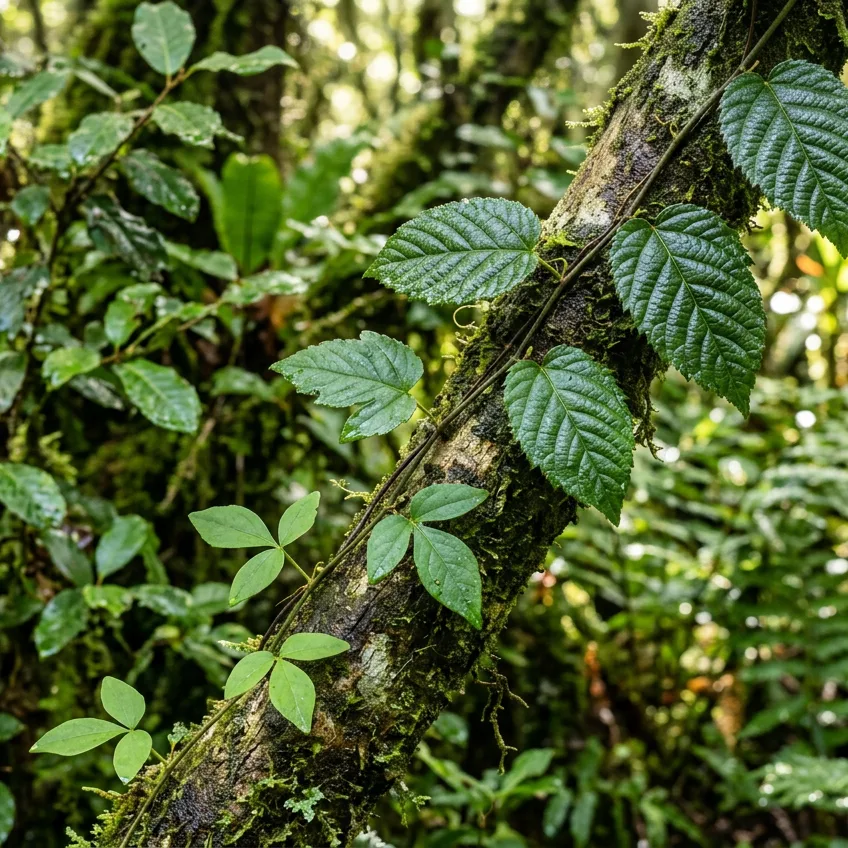
In the plant kingdom, camouflage is usually a fixed strategy shaped over millions of years of evolution. However, the vine Boquila trifoliolata, native to the temperate rainforests of southern Chile and Argentina, breaks all known botanical rules: it is capable of actively modifying the morphology of its own leaves according to the tree it climbs.
Discovered in detail in 2014 by botanists Ernesto Gianoli and Fernando Carrasco-Urra, this phenomenon, dubbed flexible mimetic mimicry, allows a single plant to change on the fly: if it climbs onto a bush with small, dark leaves, it shrinks and darkens its foliage; if it moves to a tree with large leaves and serrated edges, it faithfully copies their outline, thickness, and even the thorn pattern to avoid being eaten by herbivores.
The most baffling observation occurred in 2022, when an experiment set Boquila climbing on synthetic plastic leaves. Surprisingly, the plant began to replicate the silhouette and dimensions of the inanimate model. This finding ruled out the idea that the mechanism relies exclusively on chemical signals or volatile gene transfer between living plants, reviving the plant ocelli hypothesis proposed by Francis Darwin in 1905: the possibility that the plant's epidermal cells act as primitive lenses capable of perceiving rudimentary images of their surroundings.
Source: Gianoli, E. & Carrasco-Urra, F. (2014). 'Leaf Mimicry in a Climbing Plant Protects against Herbivory'. Current Biology / Plant Signaling & Behavior (White & Yamashita, 2022).