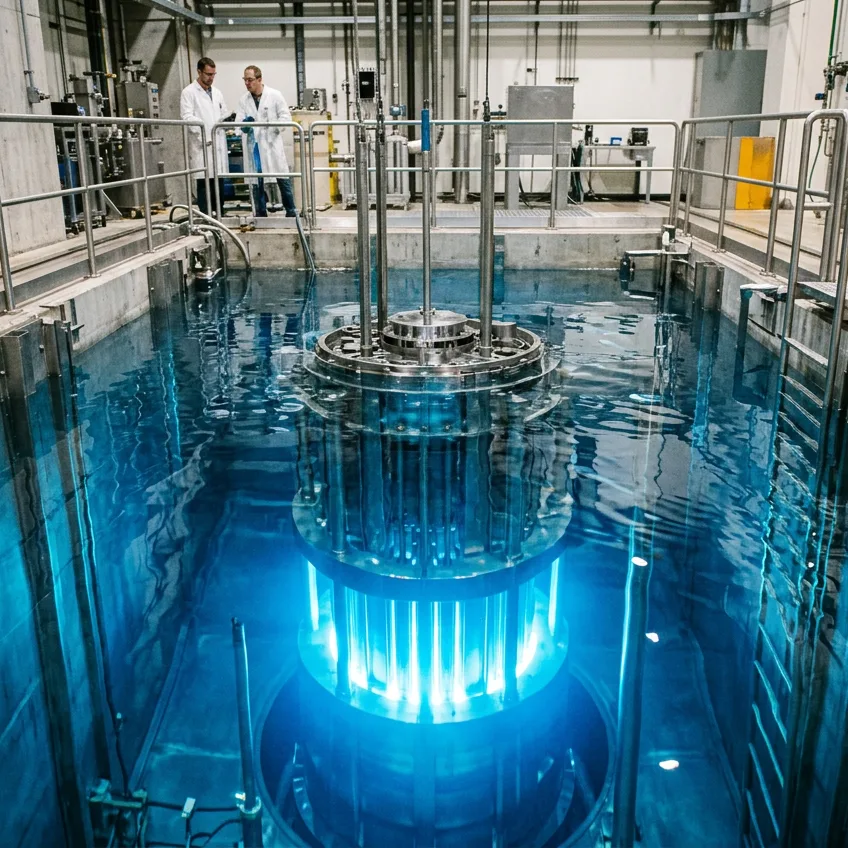
In the popular imagination, nothing can travel faster than light. However, this fundamental principle of physics contains a crucial nuance: the absolute and insurmountable limit of 299,792 kilometers per second only applies in a vacuum. When light passes through a dense medium such as water, its speed is significantly reduced to around 225,000 km/s due to the material's refractive index.
This slowdown opens an unusual window: if a charged particle—such as an electron emitted during radioactive decay in a submerged nuclear reactor—enters water at a speed greater than those 225,000 km/s, it moves locally faster than the photons themselves in that environment.
The result is the Cherenkov effect, discovered by Soviet physicist Pavel Cherenkov in 1934, an achievement that earned him the Nobel Prize in 1958:
- An electromagnetic shock wave: Just as a supersonic airplane compresses the air and produces a sonic boom when breaking the sound barrier, the particle disrupts the electrons of the surrounding water molecules, generating a coherent shock front of photons.
- A characteristic cobalt blue: The waves constructively interfere at very short wavelengths, concentrating in the ultraviolet and visible blue spectrum, tinting nuclear fuel pools with a ghostly bluish glow.
Today, this astonishing luminescence is not just a visual signature of atomic energy; it is the key tool in giant neutrino and cosmic ray detectors, such as IceCube in Antarctica or Super-Kamiokande in Japan, which use cubic kilometers of ultra-pure water or ice to monitor the invisible universe.
Source: European Organization for Nuclear Research (CERN) / Nobel Prize Outreach