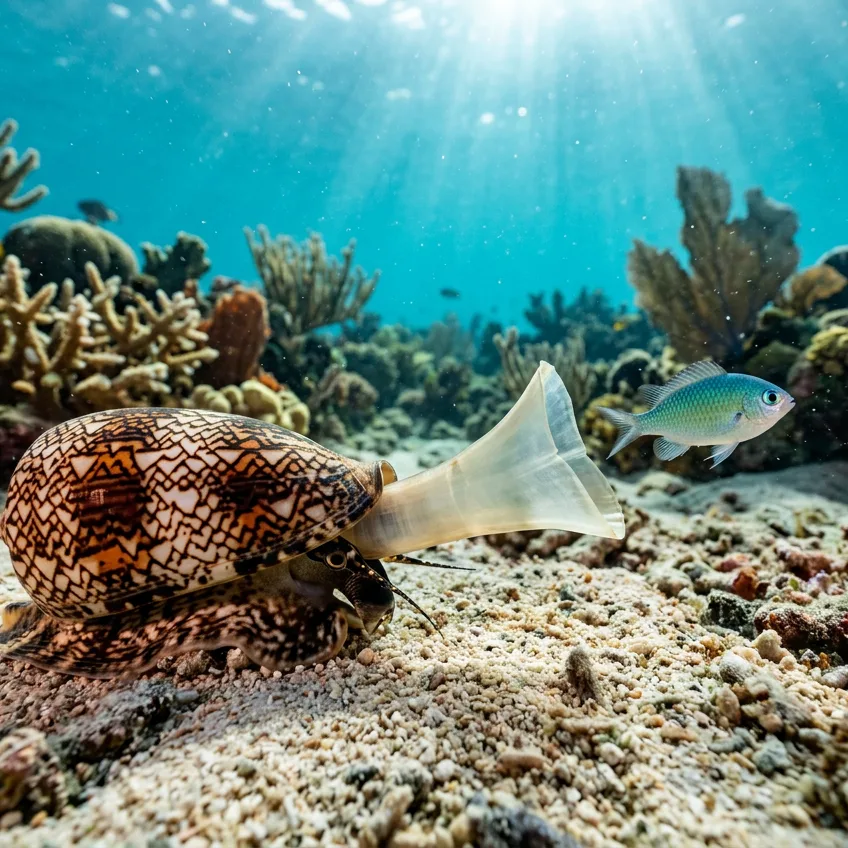
In the tropical reefs of the Indo-Pacific lives one of the most refined killers in the animal kingdom: the geography cone snail (Conus geographus). Unlike other predators that chase their prey with strength or fangs, this slow gastropod mollusk relies on an unusual biochemical weapon: it synthesizes functional insulin in its own venom to knock out entire schools of fish.
The finding, confirmed by researchers at the University of Utah and published in PNAS, revealed that the snail produces a specific conotoxin dubbed Con-Ins G1. It is the smallest and fastest active version of insulin known in nature, stripped of the molecular segments that slow its assimilation in vertebrates:
- Invisible attack: Upon detecting nearby fish, the snail does not need to sting them directly; it releases an invisible chemical cloud into the water that the prey absorb through their gills.
- Shock in seconds: The weaponized insulin immediately enters the fish's bloodstream, triggering a radical collapse of its blood glucose levels.
- Effortless capture: Stunned by a sudden hypoglycemic coma, the fish become immobile and float docily in what biologists call the 'nirvana cabal'.
Once the prey lose consciousness and the ability to escape, the snail extends its large membranous mouth funnel and engulfs them whole with total calm. This compound is not only lethal to marine animals and dangerous to divers, but it has also inspired modern medicine to develop ultrafast human insulins that act instantly after meals.
Source: Safavi-Hemami, H. et al. (2015). 'Specialized insulin is used for chemical warfare by fish-hunting cone snails'. Proceedings of the National Academy of Sciences (PNAS), 112(6), 1743-1748.