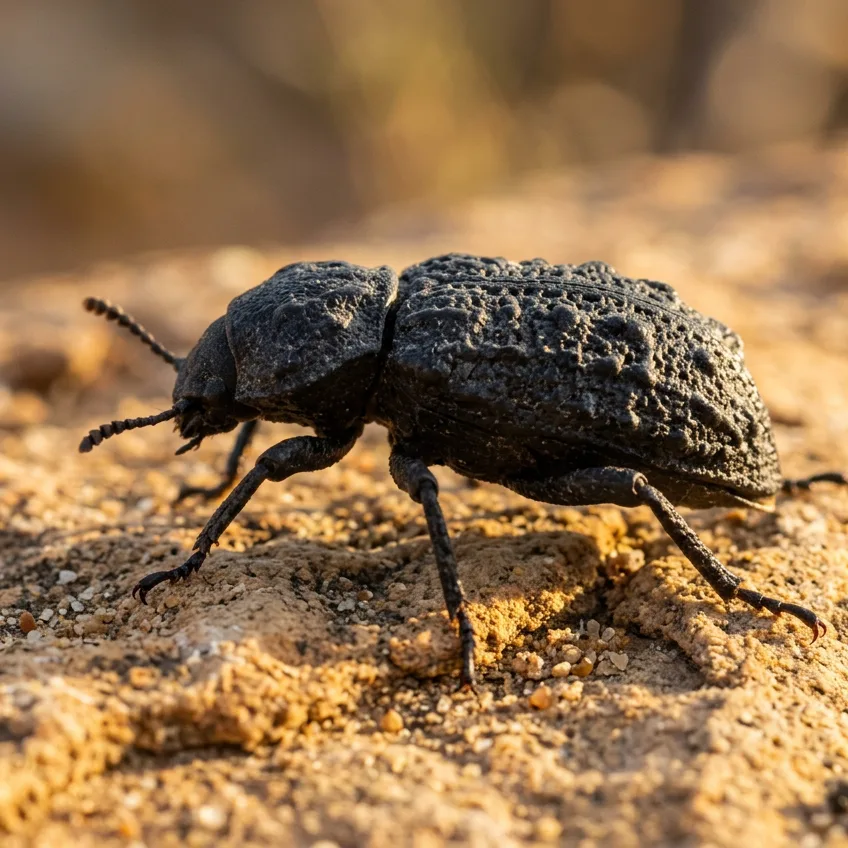
In the deserts of southwestern North America lives a creature with nearly indestructible mechanical resistance: the diabolical ironclad beetle (Phloeodes diabolicus). Unlike other flying beetles, this insect cannot take flight. In return, evolution welded its forewings into biological armor so formidable that it comfortably withstands a car driving over it without suffering damage.
In 2020, a team of engineers from the University of California, Irvine revealed the secret of its exoskeleton in the journal Nature. The scientists discovered that it can withstand a force of up to 149 newtons, a pressure equivalent to about 39,000 times its own body weight. For a 70 kilogram human, the biological equivalent would be surviving the direct impact of a mass over 2,700 tons.
The mystery lies in the dorsal suture that joins its two elytra. Instead of a rigid or fragile bond, this joint features a geometry similar to interlocking puzzle pieces, composed of multiple microscopic layers of chitin and proteins:
- Controlled delamination: Under brutal compression, the internal layers do not shatter at once; they slide and fracture microscopically in a progressive manner to dissipate mechanical energy.
- Fastening without fracture: The elliptical geometry of the tabs distributes stress evenly, preventing the shell from splitting open.
This biomechanical marvel not only allows the beetle to elude bird pecks and mammal stomps, but it is also already inspiring the design of new rivets and composite material joints for aviation turbines and aerospace infrastructure.
Source: Nature (2020) - 'Toughening mechanisms of the elytra of the diabolical ironclad beetle' by Jesus Rivera et al.