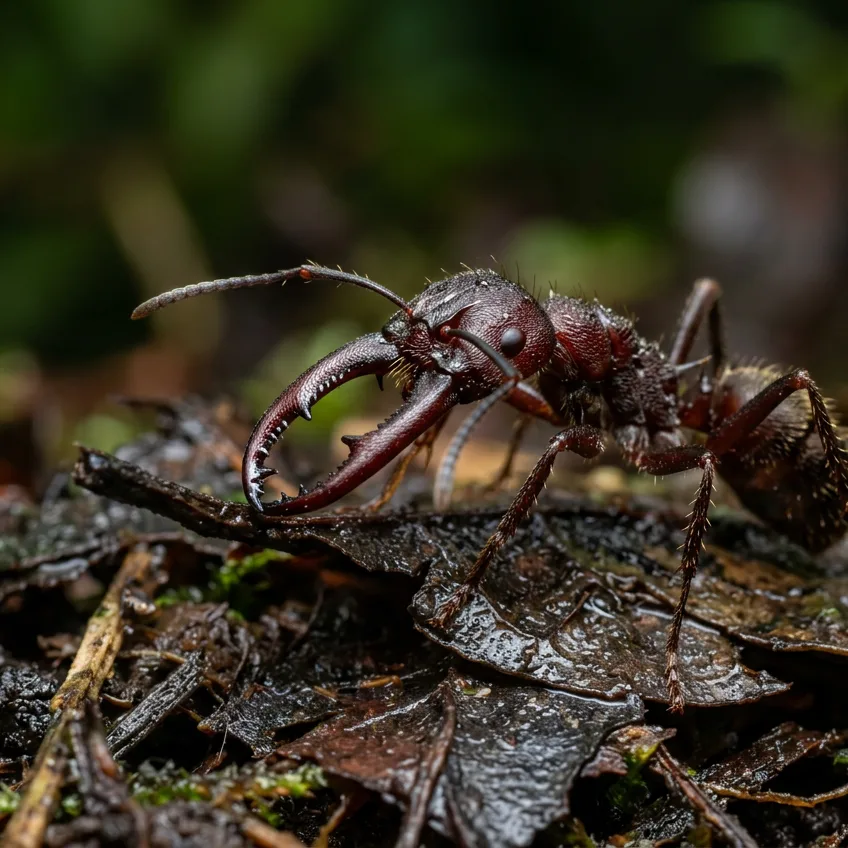
In the animal kingdom, extreme speed is often associated with the cheetah or the peregrine falcon, but the absolute record for biological acceleration belongs to an underground insect from Southeast Asia and Australia: the Dracula ant (Mystrium camillae). In 2018, entomologists from the University of Illinois and the Smithsonian Museum documented that this tiny predator executes the fastest motorized movement ever measured in a living being.
Unlike ants with conventional trap-jaws that bite from an open position, Mystrium camillae operates like an internal elastic spring: it presses the tips of its mandibles together, building up enormous tension. As one slides over the other, precisely mimicking the snap of human fingers, a strike is unleashed that reaches 324 km/h (90 meters per second) in just 23 microseconds. The acceleration exceeds 160,000 g, instantly knocking out or severing centipedes and protected prey underground.
However, its taxonomic name is not due to this lethal spring, but to a dark nutritional adaptation:
- Adult inability: Adults lack enzymes to digest the solid tissues of their captured prey.
- Delegated digestion: They deliver the hunted meat to their larvae, the only ones capable of chewing and assimilating it.
- Larval vampirism: Workers and the queen carefully pierce the abdomen of their own living young to drink their hemolymph or 'blood'.
This unusual internal parasitism does not kill the larvae, which heal and survive to become future workers of the colony.
Source: Royal Society Open Science (Larabee et al., 2018 - 'Snap-jaw morphologies and mechanics in Dracula ants')