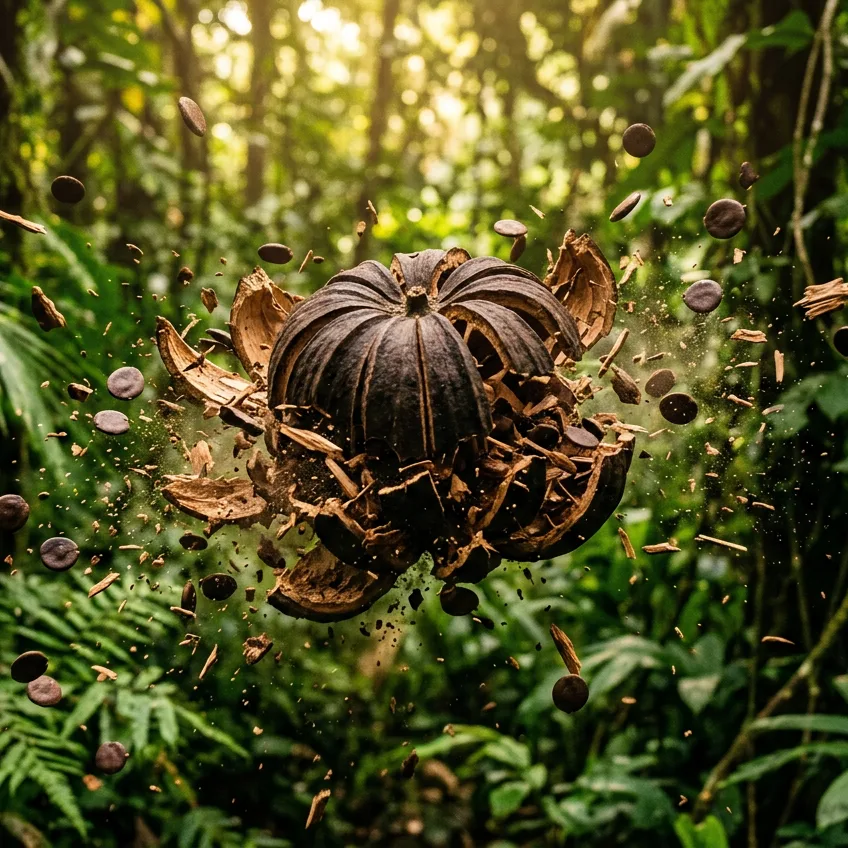
In the tropical rainforests of the Americas lives one of the most formidable trees in the plant kingdom: Hura crepitans, popularly nicknamed the "dynamite tree" or "sandbox tree". Beyond its trunk covered in dense conical thorns and its caustic sap loaded with huratoxin, the plant stands out for a propagation method known in botany as explosive ballochory.
The fruit of this species resembles a small wooden pumpkin divided into carpellary segments. As it ripens under the tropical heat, the different cellular layers of the shell dry out at uneven rates, building up brutal elastic tension in opposite directions. When the resistance of the plant tissue yields to critical dehydration, the fruit does not open slowly: it violently disintegrates in an authentic detonation that produces a bang audible hundreds of meters around.
Plant biomechanics studies have determined that this blast flings the seeds with astonishing acceleration, reaching speeds of up to 70 meters per second (about 250 km/h). This propulsion allows the seeds to be cast up to 45 meters from the original trunk, outranging ground predators and ensuring that new sprouts do not compete with the parent tree's shade.
Source: Vogel, S. (2005). Living in a physical world: mechanical designs to resist and utilize forces. Journal of Biosciences / Nature (1994).