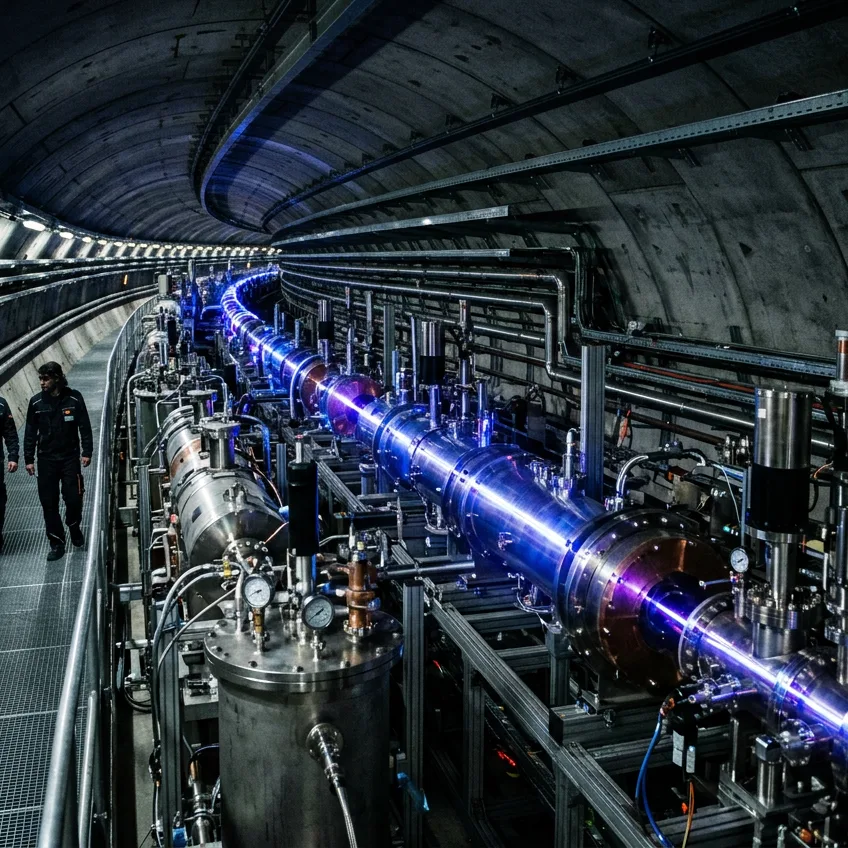
Watching a chemical bond break or form seemed physically impossible: these phenomena take place on scales of femtoseconds, that is, one quadrillionth of a second. To freeze such speed, the international scientific community built the European XFEL in Germany, the most powerful and advanced X-ray free-electron laser on the planet.
Located in an underground tunnel network spanning 3.4 kilometers between Hamburg and Schenefeld, this technological colossus accelerates electron bunches to nearly the speed of light using superconducting cavities cooled with liquid helium to -271 °C. By forcing the electrons to meander through arrays of powerful undulator magnets, the particles emit extremely concentrated and coherent synchrotron radiation: up to 27,000 X-ray flashes per second, a rate hundreds of times higher than any other similar facility.
The result is a motion-picture camera for the nanoworld. Its pulses are so intense and brief that they obtain a sharp diffraction pattern of a molecule in fractions of a second before the laser's own energy disintegrates the sample. Thanks to this technique, scientists can stitch frames together to shoot true "molecular movies," observing live how enzymes activate drugs, how chlorophyll absorbs light, or how atoms rearrange in materials subjected to extreme planetary pressures.
Source: European XFEL / Nature Photonics