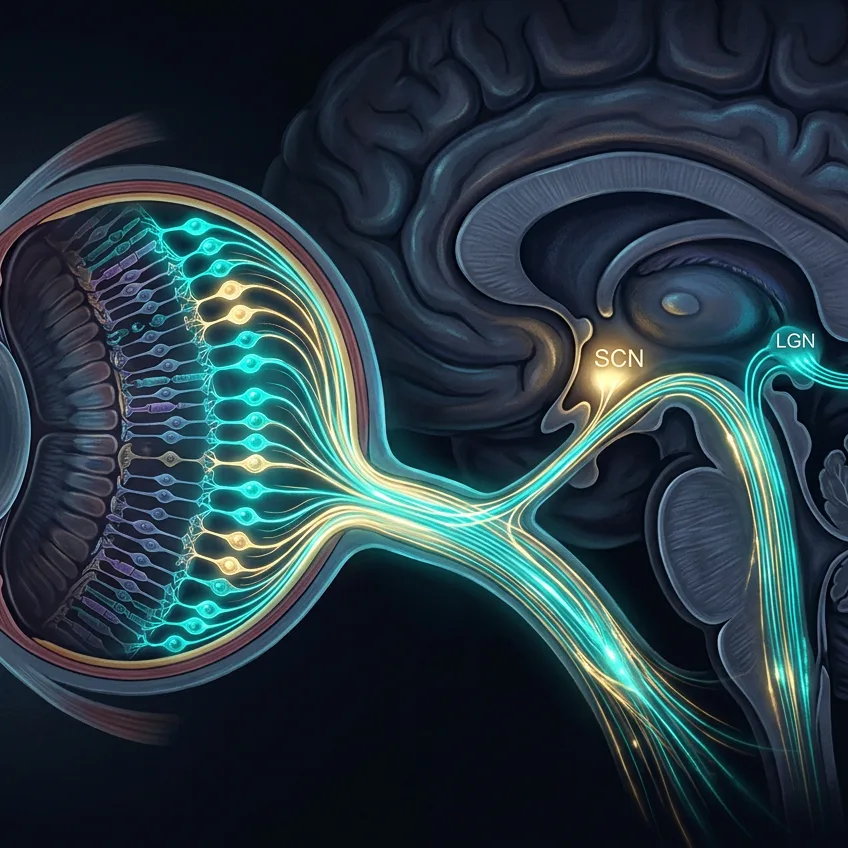
For more than a century, medical textbooks claimed that rods and cones were the only photoreceptors in the human eye. However, in early 2002, a team of neuroscientists led by David Berson confirmed the existence of a third type of ocular sensor: intrinsically photosensitive retinal ganglion cells (ipRGCs).
These cells represent barely between 1% and 2% of retinal neurons and do not participate in image formation. Their mission is not to show you the objects around you, but to inform your body what time it is in the outside world. ipRGCs harbor a special photopigment called melanopsin, which responds optimally to wavelengths close to 480 nanometers, the exact tone of natural light from a clear sky.
Upon activation by daylight, they project a direct signal to the suprachiasmatic nucleus, the main biological pacemaker of the hypothalamus. This circuit triggers crucial metabolic effects:
- Melatonin shutdown: It halts the secretion of the sleep hormone in the pineal gland to raise wakefulness.
- Hormonal and metabolic calibration: It modulates the morning release of cortisol, regulates body temperature, and optimizes insulin sensitivity.
- Mood regulation: It connects with structures of the limbic system, directly influencing mood and preventing seasonal affective disorder.
The finding was so revealing that it explains why people with total blindness due to rod and cone degeneration can maintain an impeccable sleep cycle: as long as their ipRGCs are intact, their eyes continue to synchronize the body's internal machinery perfectly.
Source: Science (David Berson et al., 'Phototransduction by Retinal Ganglion Cells That Set the Circadian Clock')