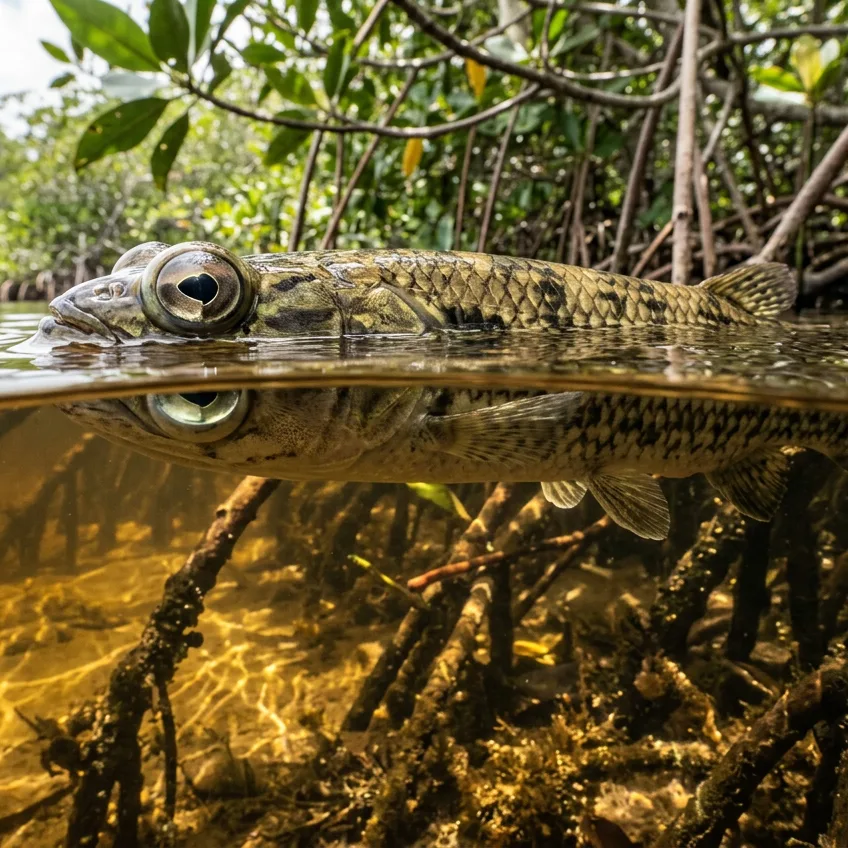
In the estuaries and mangroves of Central and South America lives a vertebrate with one of the most fascinating biological solutions to the laws of optical physics: the four-eyed fish (Anableps anableps). Although it has only two eyeballs, its anatomy is split so precisely that it allows it to operate as if it had four independent eyes.
Seeing clearly in air and water requires incompatible optics. In air, the curved cornea refracts and focuses light; however, underwater, because the liquid has a density similar to the internal fluids of the eye, the cornea loses nearly all its focal power and the animal requires an extremely spherical crystalline lens. Anableps solved this physical challenge through an astonishing adaptation:
- Divided pupil: A horizontal band of pigmented epithelial tissue cuts across the cornea right at the waterline, creating two pupillary openings per eye.
- Pear-shaped lens: The internal lens is asymmetrical. The upper half, which receives light from the air, is flat to prevent overfocusing; the lower, submerged half is highly convex to compensate for aquatic refraction.
- Two distinct retinas: The back of each eyeball houses two separate retinal sectors with photoreceptor densities calibrated for two different light environments.
By swimming permanently grazing the surface, this fish can simultaneously focus on a swooping bird of prey and a predatory fish lurking in the depths, showing how evolution sculpts anatomy to conquer two worlds at once.
Source: Journal of Experimental Biology (Studies on the Optics and Retinal Structure of Anableps anableps)