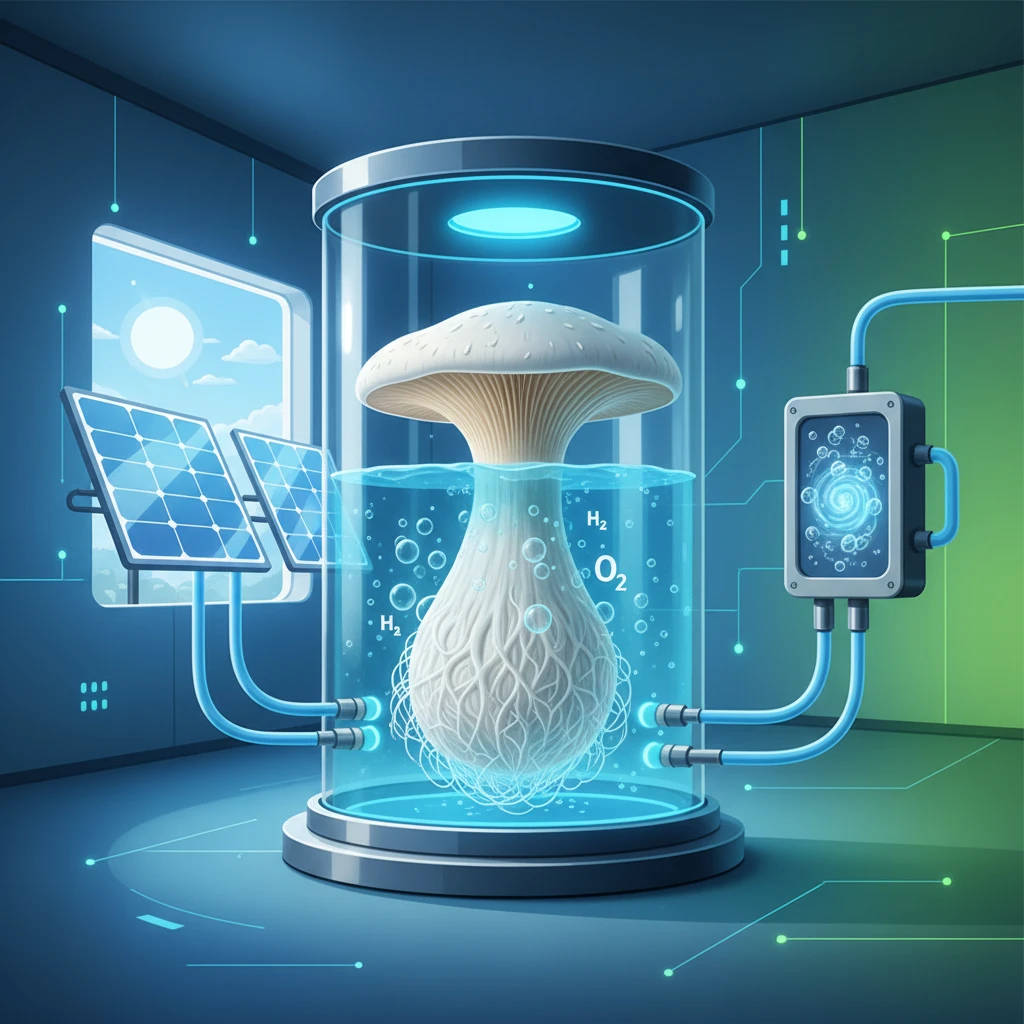
Imagine a food that needs no soil, water, or sunlight to grow, just electricity and the carbon dioxide we exhale. Scientists at Wageningen University in the Netherlands have successfully grown the edible fungus Pleurotus eryngii (known as the king oyster mushroom) in a bioreactor that uses renewable electricity to split water into hydrogen and oxygen. The fungus consumes the hydrogen and CO2 to synthesize proteins and carbohydrates, achieving a yield ten times higher than soybeans per hectare, but without requiring arable land.
This process, described in the journal Nature Food in 2022, not only produces food ultralocally (even on space stations or in deserts), but also acts as a carbon sink, removing CO2 from the atmosphere. For every kilogram of fungus produced, approximately 2 kilograms of CO2 are sequestered. The system is closed: the released oxygen can be breathed by humans, closing the loop with astonishing efficiency.
This technology could revolutionize food security in arid regions, space missions, or dense cities, eliminating the need for food transportation and drastically reducing the ecological footprint of traditional agriculture.
Source: Study published in Nature Food (2022) by the team at Wageningen University, Netherlands.