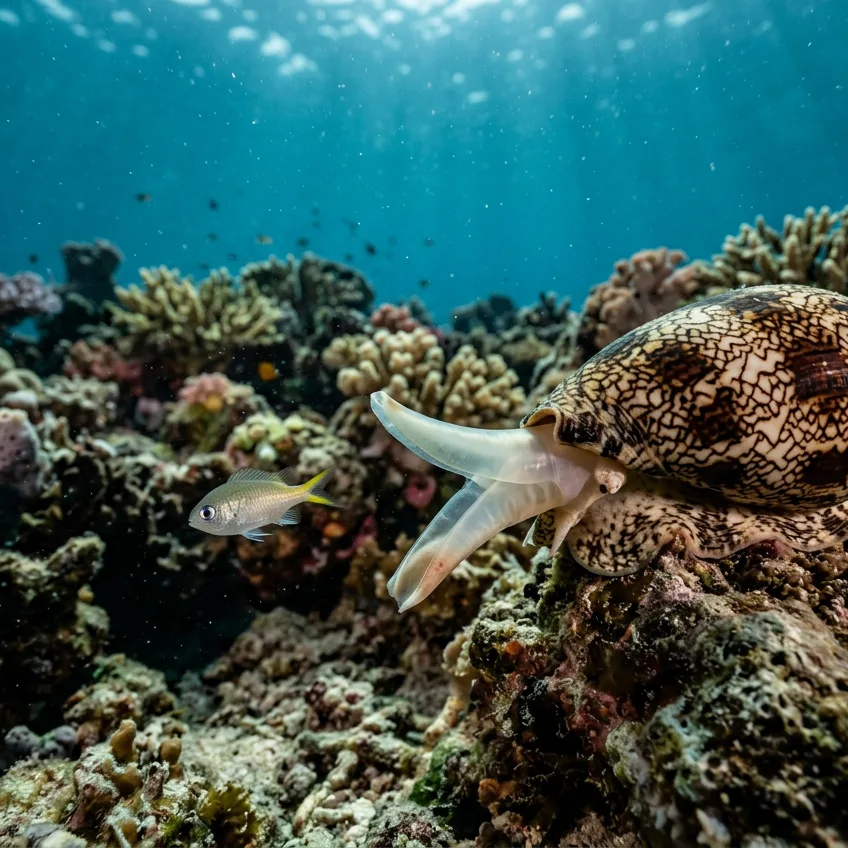
In the tropical waters of Indo-Pacific reefs lives a seemingly sluggish predator equipped with terrifying biochemical ingenuity: the geography cone snail (Conus geographus). While most predatory mollusks rely on individual toxic harpoons, this snail can subdue entire schools of agile fish using a unique strategy in the animal kingdom: the use of modified insulin as a chemical weapon.
Discovered in 2015 by scientists at the University of Utah, this species' venom contains a peptide named Con-Ins G1. When the mollusk detects nearby prey, it deploys a translucent proboscis and exhales an invisible mist loaded with toxins and mimetic insulin into the water.
The fish absorb the compound immediately through their gills, triggering a devastating physiological cascade:
- Radical hypoglycemic shock: The hormone binds with extreme affinity to the fish's insulin receptors, suddenly draining all free glucose from its bloodstream.
- Neuromuscular collapse: Suddenly deprived of basic fuel for their brain and fins, the fish become stunned and lose all motor coordination.
- Passive ingestion: Unable to activate their flight response, the victims float at the mercy of the snail, which expands its massive gastric funnel to engulf them alive.
Unlike vertebrate insulin, the molecular variant of the geography cone snail lacks the structural segments that normally delay its activation, making it the fastest-acting insulin discovered in nature. This finding not only revealed a pinnacle of predatory evolution, but it also inspires the development of ultra-fast-absorbing synthetic insulins for the treatment of human diabetes today.
Source: Proceedings of the National Academy of Sciences (PNAS)