Achieving biological transparency is relatively common in marine invertebrate organisms, but in terrestrial vertebrates it poses an almost impossible challenge due to red blood cells. Hemoglobin intensely absorbs visible light, turning blood into an opaque and telltale cue to the eyes of any predator.
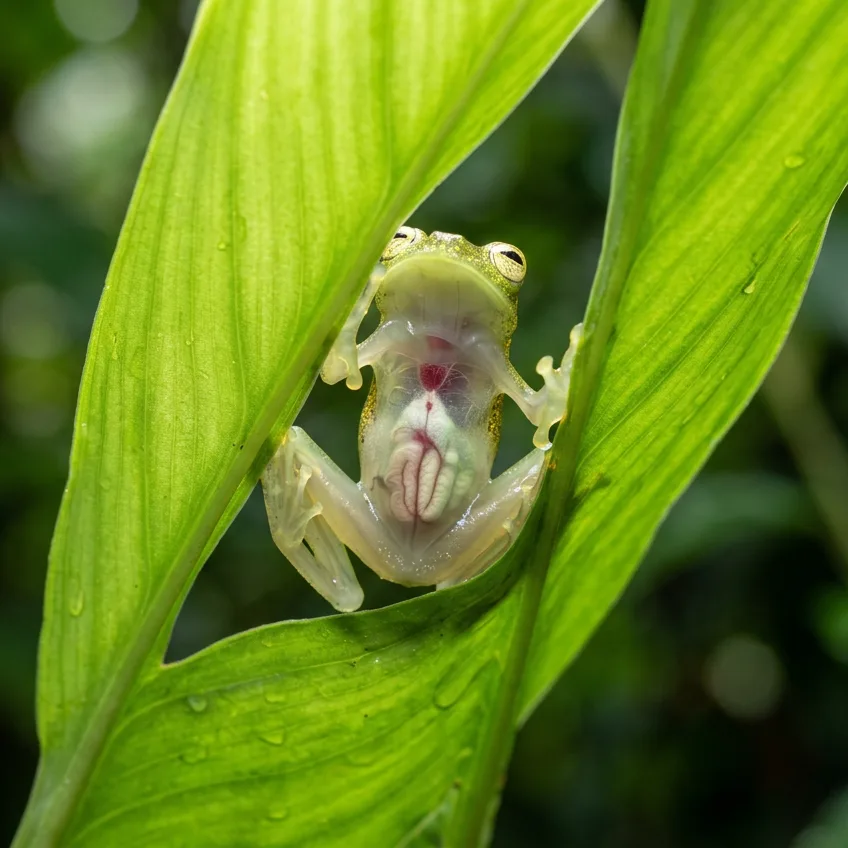
The glassfrog (Hyalinobatrachium fleischmanni), native to the tropical forests of Central and South America, solved this evolutionary dilemma with a unique circulatory feat. According to a pioneering study published in the journal Science in December 2022, the amphibian achieves its daytime camouflage through extreme cellular redistribution:
- Massive withdrawal: While sleeping perched on the underside of green leaves, the frog actively removes between 80 % and 89 % of its erythrocytes from circulation.
- Hepatic shielding: The red blood cells are stored and compressed inside its liver, an organ externally protected by reflective guanine crystals that block light and hide the reddish pigment.
- Immunity to thrombosis: The animal packs extraordinary cellular densities that in humans would cause clots and fulminant vascular events, achieving it without suffering harmful platelet aggregation.
As soon as it wakes up to jump and hunt at nightfall, its liver decompresses the load and returns the blood to the bloodstream in a few minutes, restoring the reddish hue to its vessels without any damage. This finding not only redefines the limits of camouflage in nature, but also offers a valuable biomedical clue to investigate new human anticoagulant drugs.
Source: Science (Taboada et al., 2022: 'Glassfrogs conceal erythrocytes in the liver to maintain transparency')