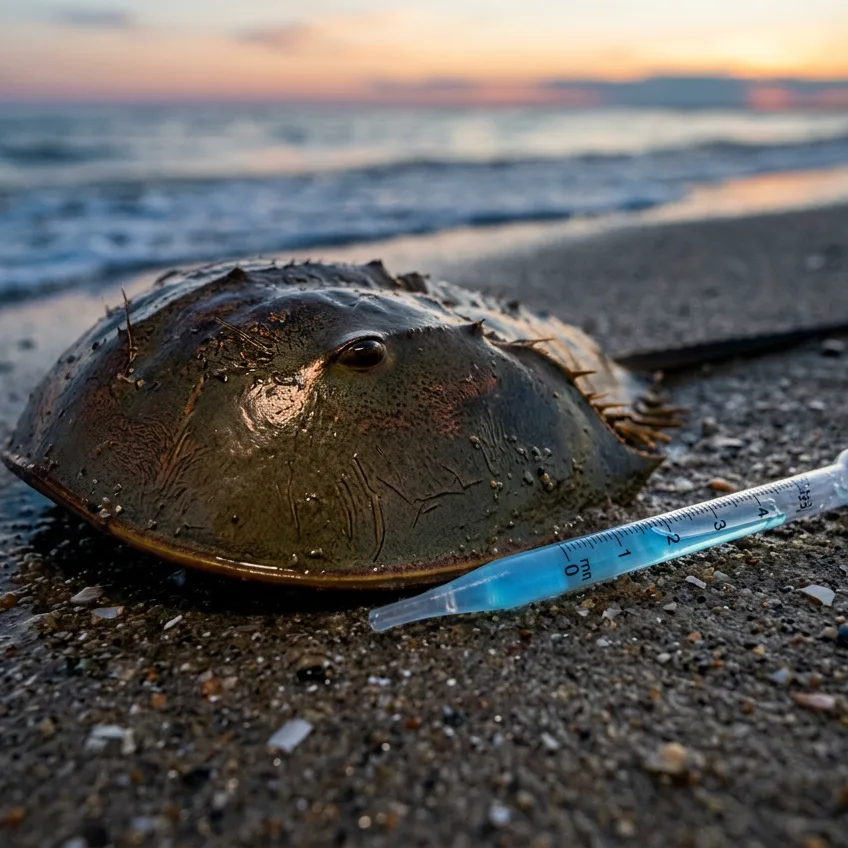
Long before the appearance of dinosaurs, more than 450 million years ago, the ancestors of the horseshoe crab (Limulus polyphemus) already patrolled ocean waters. However, their most astonishing evolutionary trait flows through their veins: blood of a striking milky blue color due to hemocyanin, a respiratory protein based on copper instead of iron.
Lacking an adaptive immune system like that of vertebrates—capable of producing specific antibodies against new pathogens—these marine chelicerates developed a primitive yet lightning-fast line of defense. Their lymph contains immune cells called amebocytes, which react to the slightest contact with endotoxins from gram-negative bacteria such as Escherichia coli or Salmonella.
In a matter of seconds, amebocytes release an enzymatic factor that clots the blood around the intruder, forming an impenetrable gelatinous barrier that neutralizes and isolates the bacterial infection. This response is so violent and sensitive that it allows the detection of trace toxins at concentrations lower than one part per trillion, equivalent to identifying a grain of sugar dissolved in an Olympic swimming pool.
Since the 1970s, the biomedical industry has harnessed this feat using the LAL (Limulus Amebocyte Lysate) test. Every vaccine, injectable serum, catheter, or surgical implant that reaches a modern hospital undergoes this biological test to certify that it is free of endotoxins that cause septicemia, turning this relative of spiders into an irreplaceable pillar of global human health.
Source: Nature Reviews Immunology / Woods Hole Oceanographic Institution (WHOI)