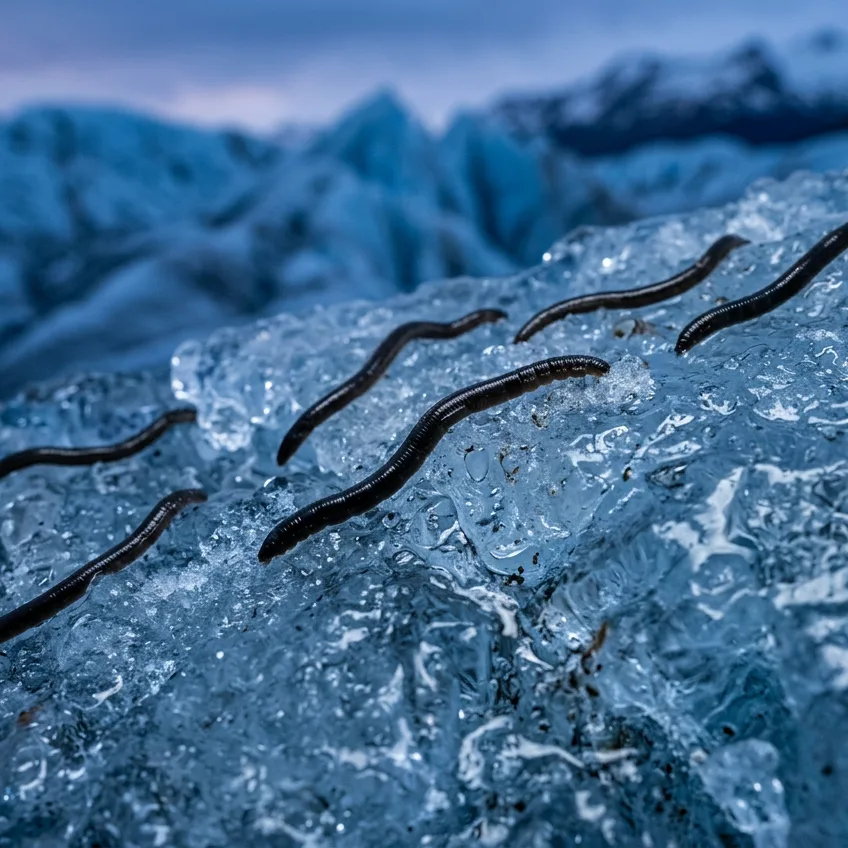
In the frozen depths of glaciers in Alaska and the Pacific Northwest lives one of the planet's most extreme biological enigmas: the glacier ice worm (Mesenchytraeus solifugus). This tiny annelid, barely two centimeters long, is the only known complex animal capable of completing its entire life cycle within solid ice, defying the most basic laws of animal biochemistry.
In virtually any living organism, extreme cold slows down chemical reactions and plummets the production of adenosine triphosphate (ATP), the cellular energy currency. However, ice worms do the exact opposite: their ATP levels rise as the thermometer drops toward the freezing point. Their metabolic enzymes have evolved to reach peak efficiency at 0 °C, while their cell membranes incorporate unsaturated lipids that prevent internal solidification.
This hyperspecialization to ice carries a lethal and fascinating trade-off:
- Thermal self-digestion: If the ambient temperature merely exceeds 5 °C, their cell membranes collapse and their enzymes spiral out of control, causing the organism to self-digest.
- Liquefaction on touch: If a human places one of these worms on the palm of their hand, body heat disintegrates it in a few seconds, literally reducing it to a smudge of dark liquid sludge.
Every summer dusk, millions of these invertebrates emerge simultaneously onto the surface of glaciers to feed on snow algae and windblown pollen, carpeting the ice in a blackish hue before retreating into the depths with the first rays of the sun.
Source: Proceedings of the National Academy of Sciences (PNAS) / Rutgers University