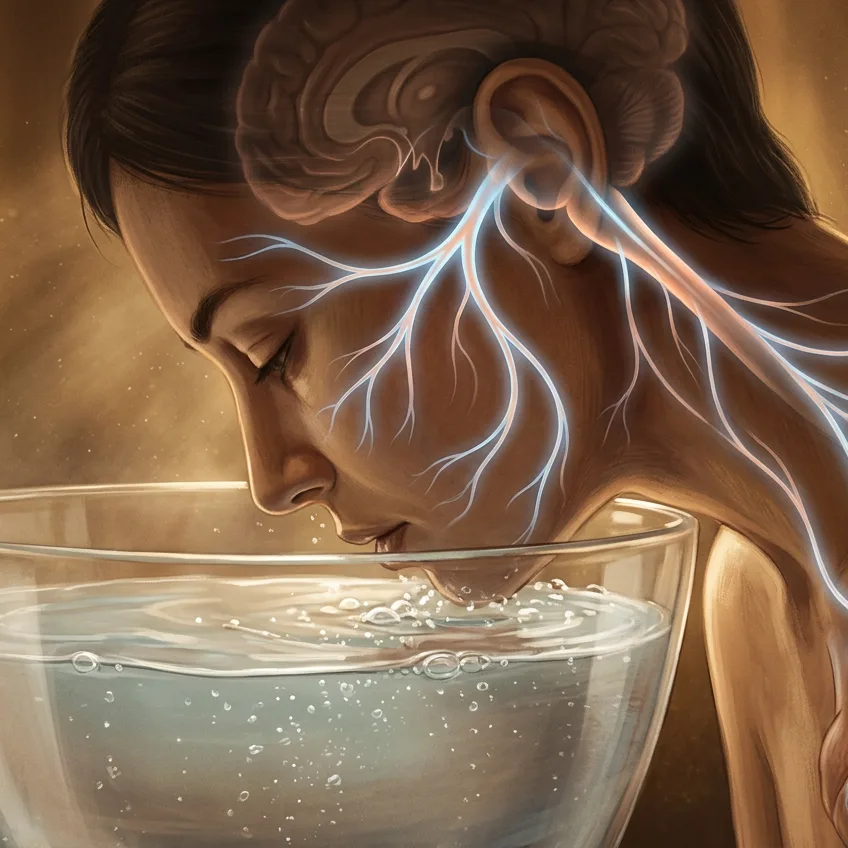
Although humans are land animals, we retain in our nervous system one of the most astonishing aquatic survival tools in the animal kingdom: the mammalian dive reflex. Shared with seals and dolphins, this mechanism is instantly triggered when the face comes into contact with water at temperatures below 15 °C.
The secret lies in the sensory receptors of the trigeminal nerve located around the eyes, nose, and cheeks. By detecting cold and wetness simultaneously, the brain interprets that the body has just submerged underwater with no oxygen available, triggering a relentless autonomic protocol:
- Reflex bradycardia: The vagus nerve fires an immediate command that slows the heart rate by 10 % to 25 % in just five seconds.
- Peripheral vasoconstriction: Vessels in the extremities constrict to redirect oxygenated blood straight to the brain and heart.
- Stress disconnect: It blocks the sympathetic "fight or flight" response, overriding hyperventilation and excess adrenaline.
Far from being a mere biological curiosity, contemporary medicine uses this reflex as a non-invasive clinical intervention. In hospital emergency rooms, it is used by immersing the face in ice water to stop episodes of paroxysmal supraventricular tachycardia. Likewise, in modern psychotherapy (such as the TIPP technique of dialectical behavior therapy), splashing the face with cold water acts as a genuine physiological switch capable of shutting down panic attacks and acute emotional overwhelm almost instantly.
Source: Journal of Applied Physiology / Harvard Medical School