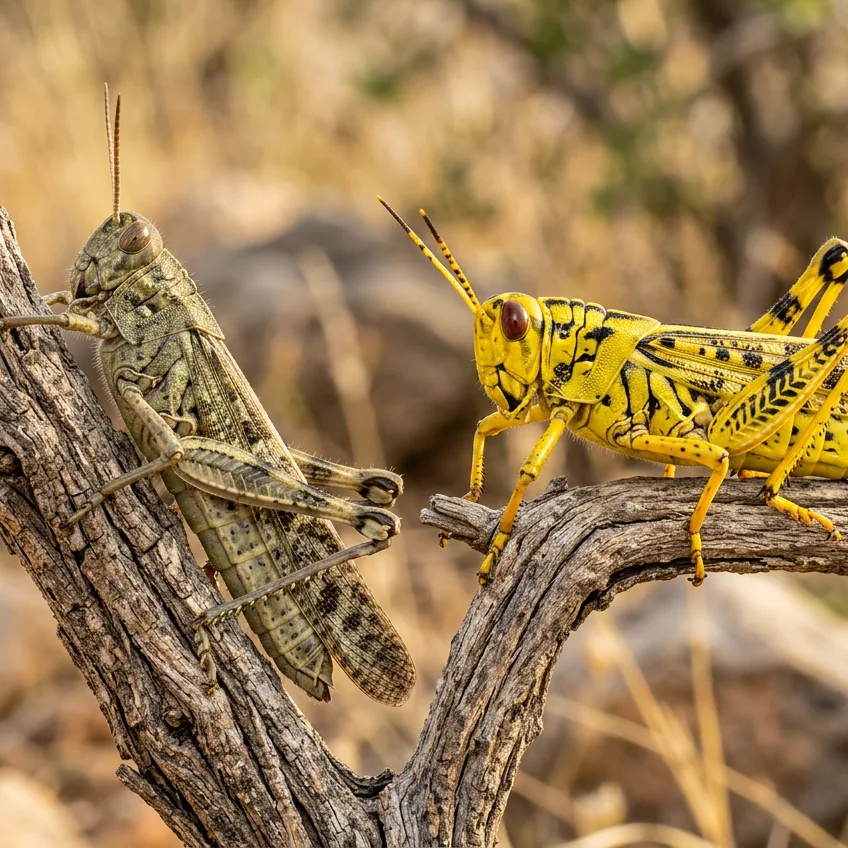
For most of its life, the desert locust (Schistocerca gregaria) is a solitary, elusive, and peaceful insect. With muted tones to camouflage itself in the sand and nocturnal habits, it actively avoids contact with other members of its species. However, when weather conditions force populations to concentrate in small patches of vegetation, one of the most extreme biological transformations on the planet occurs: the shift to the gregarious phase.
Researchers from the universities of Oxford and Cambridge discovered that the master switch for this metamorphosis is neither hormonal nor visual, but a direct mechanical stimulus. When overcrowding causes continuous rubbing among peers, the mechanoreceptor hairs located on their hind femora send frantic alert signals to the central nervous system.
This friction triggers a dizzying molecular response:
- Serotonin explosion: After just four hours of continuous tactile stimulation on the legs, serotonin levels in their thoracic ganglia triple.
- Immediate behavioral shift: Aversion toward other insects vanishes, replaced by an irresistible attraction to group together and an insatiable appetite.
- Anatomical remodeling: In subsequent molts, its color mutates into a striking toxic yellow and black pattern, its wings strengthen, and its brain mass increases by up to 30 % to process collective navigation.
Thanks to this tiny neurochemical switch, peaceful solitary grasshoppers coordinate into colossal swarms of billions of individuals capable of traveling hundreds of kilometers and devastating entire crops.
Source: Science (Anstey et al., 2009 - 'Serotonin Mediates Behavioral Gregarization in the Desert Locust')