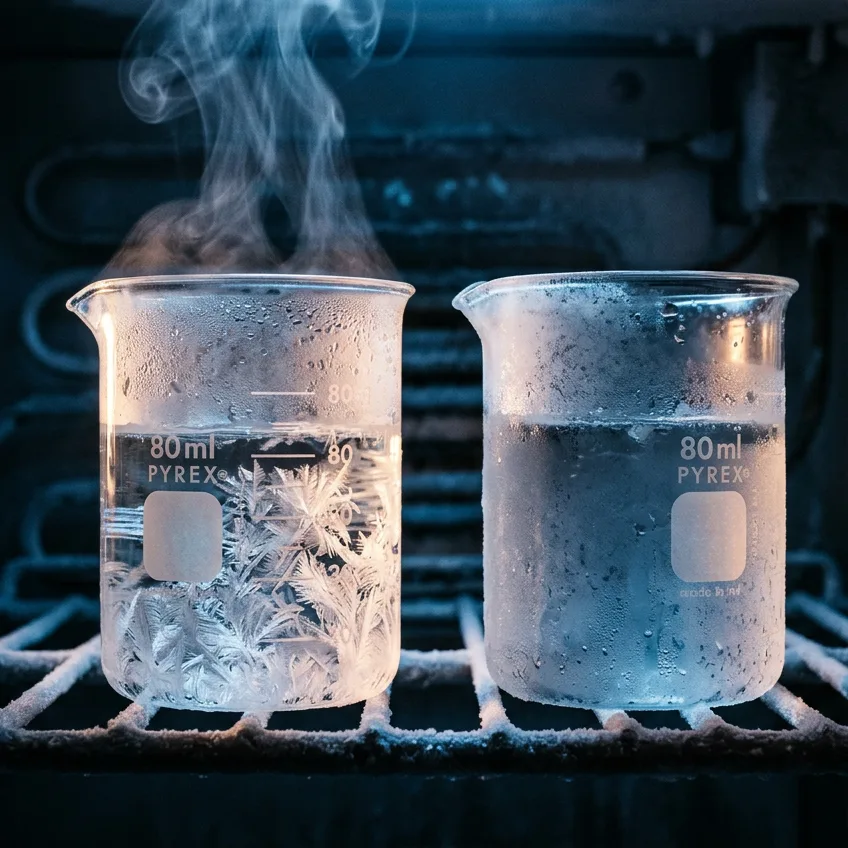
At first glance it seems to violate the fundamental laws of physics: if you place two identical containers in the freezer, one with water at 80 °C and another with water at 20 °C, under certain conditions the hot water will solidify first. This phenomenon is known as the Mpemba effect, named after Erasto Mpemba, a Tanzanian high school student who in 1963 noticed that his hot ice cream mixture froze faster than his classmates' cold mixture.
Although philosophers such as Aristotle, Francis Bacon, and René Descartes had already reported similar observations centuries earlier, the modern scientific community dismissed Mpemba's claim until physicist Denis Osborne replicated the experiment and published the results in 1969. For decades it was debated whether it was merely an experimental artifact, but recent studies using quantum technology and thermography have proven its validity.
Scientists have identified several mechanisms operating simultaneously:
- Accelerated evaporation: Hot water quickly loses mass through vaporization, leaving a smaller volume to cool.
- Vigorous convection: More intense internal thermal currents are generated, accelerating heat transfer toward the surface.
- Hydrogen bond relaxation: At the molecular level, heat stretches and weakens the hydrogen bonds between water molecules, allowing covalent bonds to store and then release thermal energy at a much faster rate upon cooling.
Source: Nature / Royal Society of Chemistry