With every daily breath we inhale thousands of dust particles, pollen, bacteria, and fungal spores suspended in the air. Despite this continuous invasion, the deep pulmonary alveoli remain practically sterile thanks to a biomechanical feat known as the mucociliary escalator.
This defense system lines most of the respiratory tree and operates like an uninterrupted biological conveyor belt. Its architecture consists of two perfectly synchronized elements:
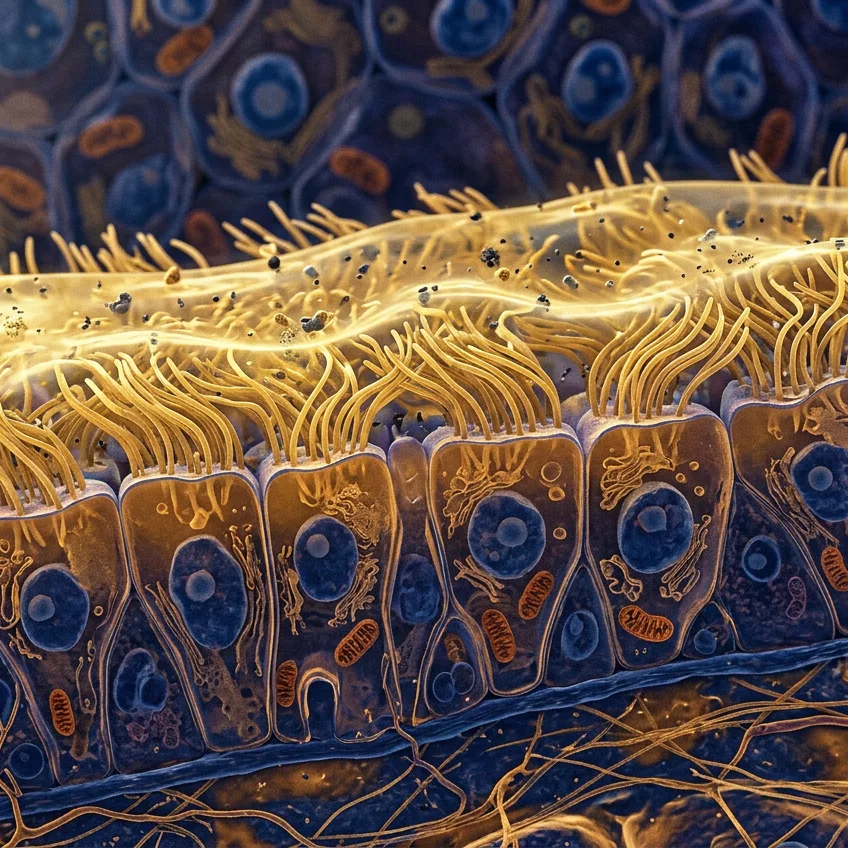
- The mucus trap: A gelatinous film rich in mucins secreted by goblet cells, responsible for trapping impurities and invading pathogens on contact.
- The ciliary engine: Epithelial cells equipped with about 200 hair-like motile microstructures (cilia) barely six micrometers long.
The cilia do not beat randomly; they beat in coordinated waves at a frequency of between 10 and 15 oscillations per second (up to 900 times per minute). The forward stroke occurs stiffly against the thick mucus layer, while the return stroke takes place flexed within an underlying watery layer. This asymmetry propels the sheet of mucus upward at a constant rate of up to 15 millimeters per minute.
Over 24 hours, this cellular escalator carries between 30 and 100 milliliters of debris-laden mucus from the bronchioles to the pharynx, where it is unconsciously swallowed so that gastric acid can annihilate biological threats. Toxins such as tobacco smoke cause ciliostasis (ciliary paralysis), which disables the mechanism and forces the body to rely on mechanical coughing to clear the airways.
Source: American Journal of Respiratory and Critical Care Medicine