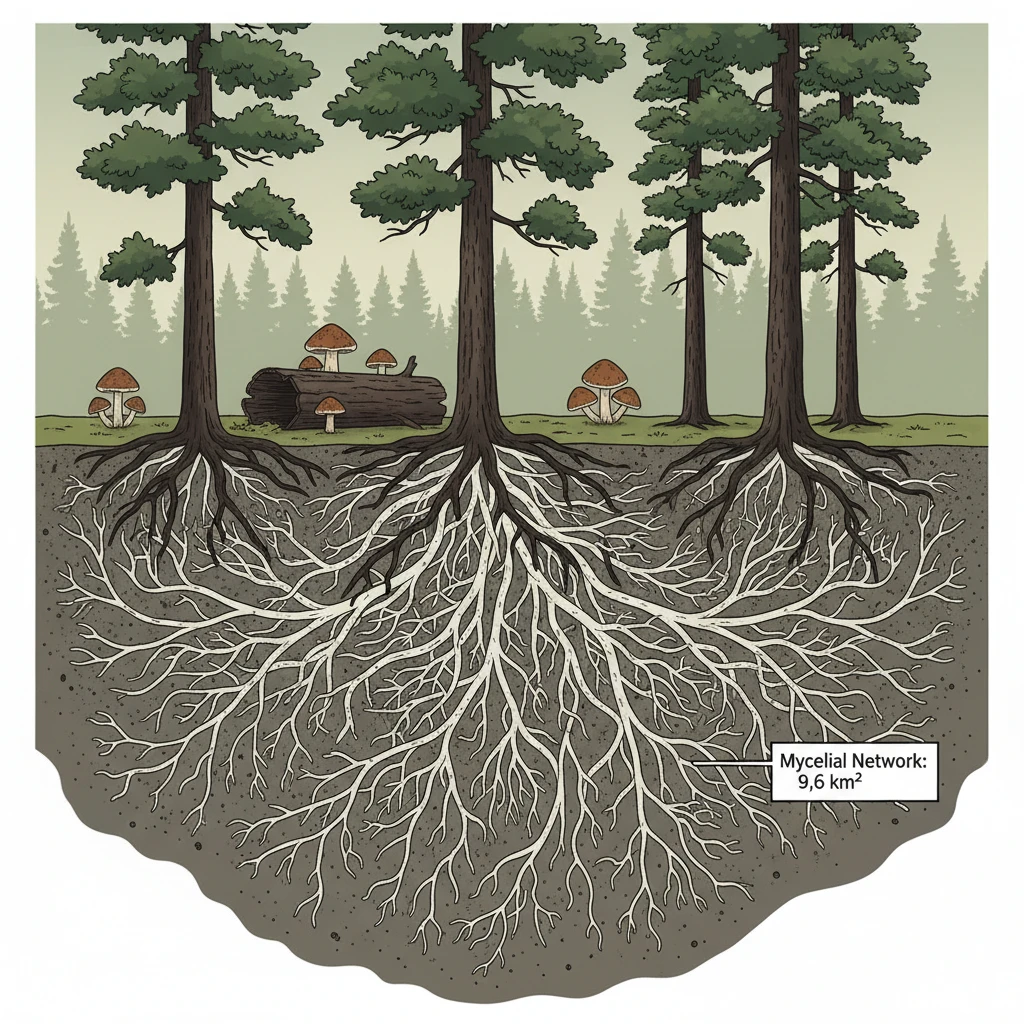
Beneath the soil of the Malheur National Forest in Oregon, United States, lives the largest known organism on Earth: a parasitic mushroom called Armillaria ostoyae. This fungal species spreads through a network of microscopic filaments covering approximately 9.6 square kilometers, an area equivalent to 1,350 soccer fields.
What is truly astonishing is that, according to genetic estimates conducted by the U.S. Forest Service, this specimen could be between 2,400 and 8,650 years old. It feeds on tree roots, killing them slowly and forming what are known as "fungal archipelagos." Although it looks like a colony of individuals, DNA tests confirm it is a single clonal organism.
- Underground network: Its filaments, called rhizomorphs, resemble black shoestrings and spread beneath the ground.
- Hunting method: It secretes enzymes that digest living wood, weakening and killing host trees.
- Ecological impact: Although a pathogen, it also recycles nutrients and creates forest clearings that foster biodiversity.
This invisible giant challenges our concept of what an individual "living being" is and shows that nature holds wonders that often go unnoticed right beneath our feet.
Source: U.S. Forest Service (USFS) - Genetic studies in Malheur National Forest