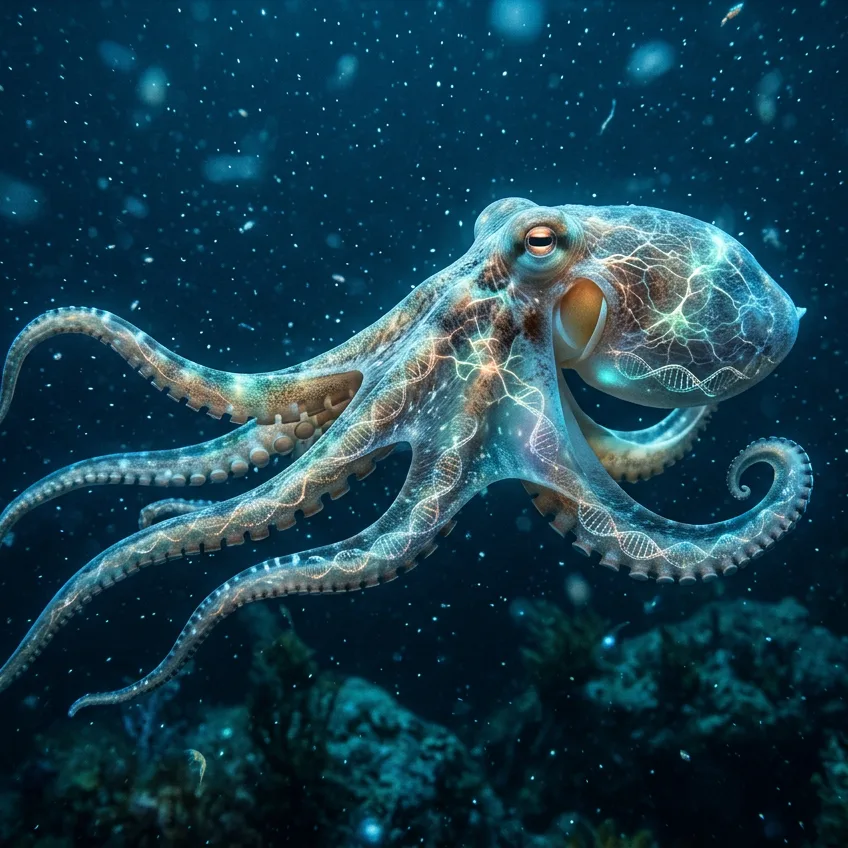
In the vast majority of the animal kingdom, the instructions of life follow a strict rule: DNA is transcribed into messenger RNA, and this is faithfully translated to make proteins. Any adaptive change usually requires thousands of years of genetic mutations. However, octopuses and other coleoid cephalopods discovered an astonishing biological shortcut: they are capable of massively rewriting their own RNA on demand without altering a single letter of their original genome.
This phenomenon is known as adenosine-to-inosine (A-to-I) RNA editing, orchestrated by specialized enzymes called ADARs. While in humans this modification alters barely a minimal fraction of nervous system proteins, in the octopus it affects more than 60 % of its neural transcripts. Thanks to this, a single gene can produce dozens of different protein versions depending on the needs of the moment.
Research led by the Marine Biological Laboratory in Woods Hole and Tel Aviv University showed that this mechanism acts like a sophisticated molecular thermostat. When ocean temperatures drop suddenly, the animal edits thousands of specific sites in its RNA in a matter of hours. It modifies key parts of its cellular machinery, such as:
- Kinesins: molecular motors that transport vesicles along neural axons.
- Synaptotagmins: proteins that act as calcium sensors essential for synaptic transmission.
By adjusting the structure and flexibility of its proteins on the fly, the octopus prevents its nerve impulses from slowing down in extreme cold, demonstrating a biological plasticity unmatched on the planet.
Source: Cell / Marine Biological Laboratory (MBL)