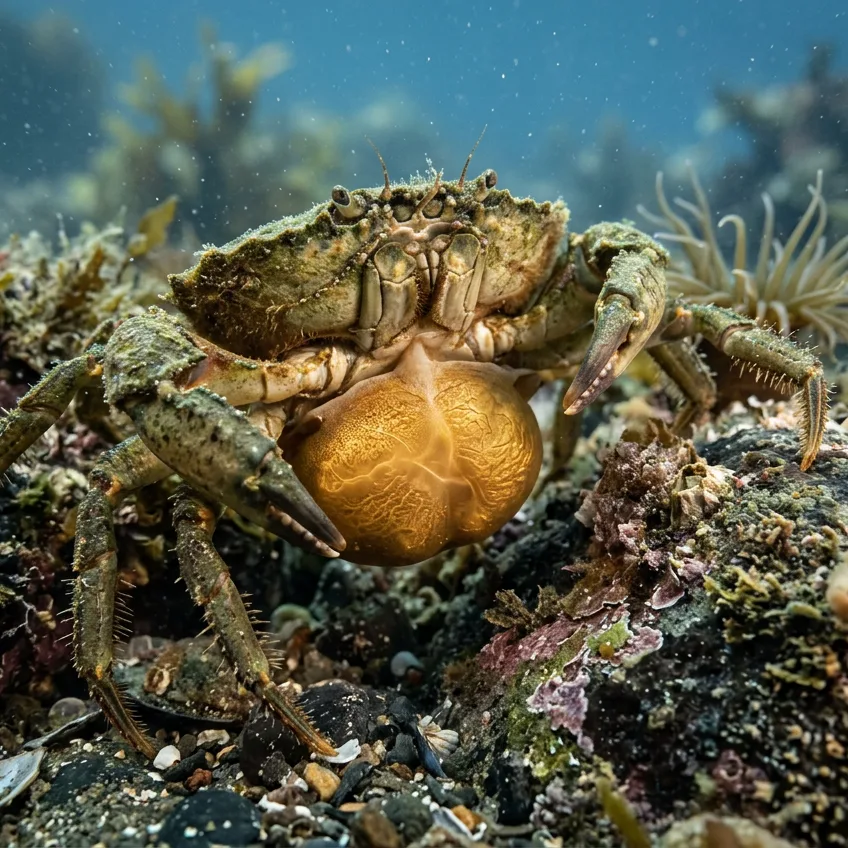
On the seabeds of the Atlantic coastlines, one of the most extreme biological manipulation processes on the planet takes place at the hands of Sacculina carcini, a cirripede taxonomically related to barnacles that completely lacks the traditional appearance of a crustacean.
The infection process begins when a microscopic female larva detects a common shore crab. Landing on one of its leg joints, it sheds its carapace, legs, and antennae, reducing itself to a hollow cellular dart called a kentrogon. Through this structure, it injects a few cells into the crab's circulatory system. Once inside, these cells proliferate and extend a complex network of branching roots that wraps around the host's internal organs and nervous system, absorbing nutrients from its hemolymph.
The physiological and behavioral consequences of this invasion are devastating:
- Parasitic castration: It completely destroys the crab's reproductive organs, preventing it from expending metabolic resources on gamete production.
- Hormonal feminization: If the parasitized crab is male, the organism alters its endocrine balance; its abdomen widens to resemble that of a female, and masculine aggressive behaviors are inhibited.
- Hijacking of parental behavior: The parasite develops an external reproductive sac beneath the crustacean's abdomen. The host crab treats this foreign mass as if it were its own clutch of eggs, protecting, grooming, and aerating it periodically.
When the time comes to hatch, the crab instinctively climbs a rock exposed to the current and waves its claws to disperse the new generation of parasitic larvae into the water, completing an astonishing biological hijacking.
Source: Journal of Experimental Marine Biology and Ecology