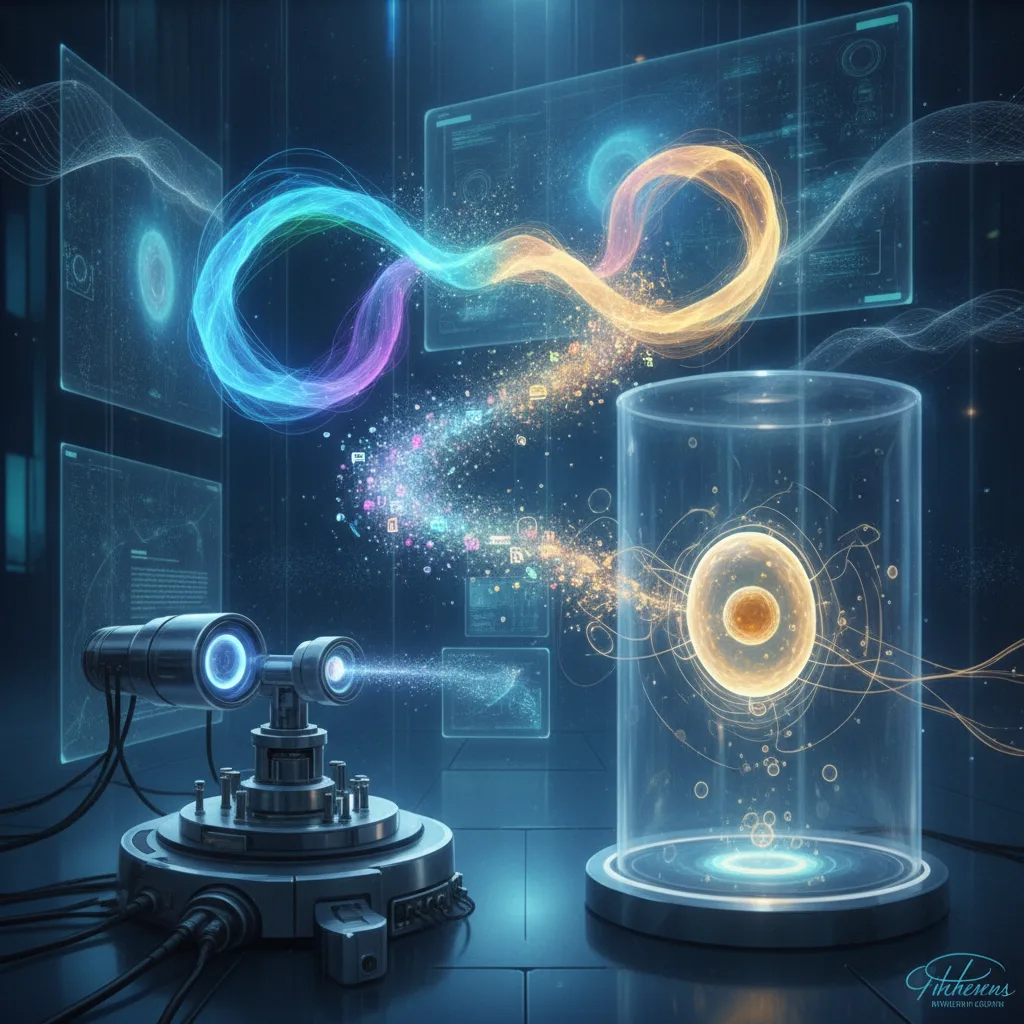
Imagine being able to "see" a living cell, a sensitive molecule, or a delicate circuit without the light from your microscope damaging or altering them. Traditional microscopy, while powerful, often requires light to interact directly with the sample, which can be destructive, especially for sensitive or biological materials.
This is where the surprising world of quantum entanglement comes into play, a phenomenon where two particles are so deeply connected that measuring one instantly affects the state of the other, regardless of distance. Scientists are harnessing this "spooky action at a distance" to develop a new generation of imaging techniques that promise to revolutionize fields like medicine and materials science.
One of these innovations is "interaction-free imaging" or "quantum microscopy." It works in an ingenious way: pairs of entangled photons are created. One photon, the "witness," travels to a detector. The other, the "interrogator," is directed toward the sample. However, instead of passing through and damaging it, the interrogator simply passes near the sample or is blocked by it without interacting directly. If the interrogator is blocked, its absence alters the state of the witness photon, which never touched the sample. This change in the witness reveals the presence and properties of the sample.
The benefits are remarkable: it allows imaging of extremely fragile structures without altering them, observing objects through opaque media, and even surpassing conventional optical resolution limits with less light. This technology could mean more precise non-invasive medical diagnoses, the study of biological processes in real time, or the analysis of light-sensitive materials in ways never before possible.
Source: Scientific articles on "quantum imaging" or "interaction-free measurement" in journals such as Nature Photonics, Science Advances, or Physical Review Letters. Institutions like MIT or the University of Vienna are pioneers.