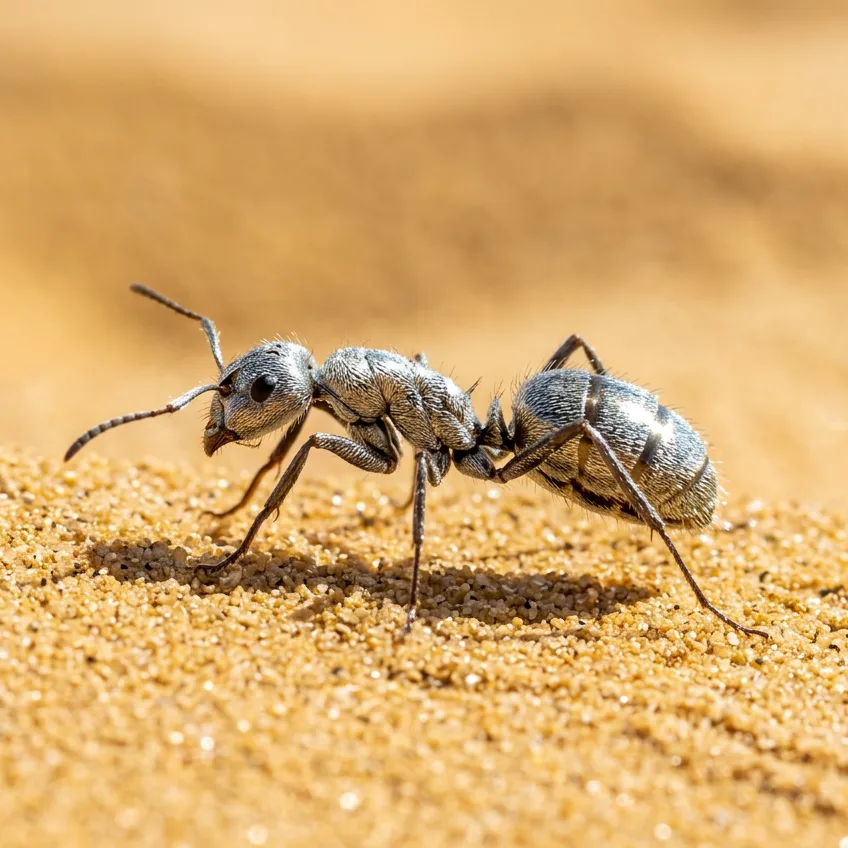
At midday in the dunes of the Sahara Desert, the sand reaches surface temperatures bordering on 70 °C. At that extreme hour, practically any predator flees to take shelter underground to avoid burning to death. It is precisely at this lethal moment that the Saharan silver ant (Cataglyphis bombycina) emerges on lightning raids of barely ten minutes to scavenge heat-stricken insects.
To avoid cooking alive, this species has developed one of the most astonishing thermal solutions in the animal kingdom:
- Microscopic triangular hairs: Its back is not covered by ordinary hair, but by dense bristles with a triangular cross-section. These facets act as tiny optical prisms that generate total internal reflection, bouncing back almost all visible sunlight and near-infrared light.
- Passive radiative cooling: The geometry of these hairs does not just act as a near-perfect mirror; it also maximizes the emission of body heat in the mid-infrared band, sending excess thermal energy directly toward the cold sky above.
- Supersonic speed at scale: It manages to cover almost one meter per second with its long legs, equivalent to hundreds of times its body length, lifting itself off the sand to allow the breeze to lower its temperature.
Thanks to this natural thermal suit, which inspired engineers at Columbia University in designing new electricity-free cooling materials, the silver ant keeps its body temperature below its lethal biological limit of 53.6 °C in one of Earth's most unforgiving hells.
Source: Science (Shi et al., 'Keeping cool: Enhanced optical reflection and radiative heat dissipation in Saharan silver ants')