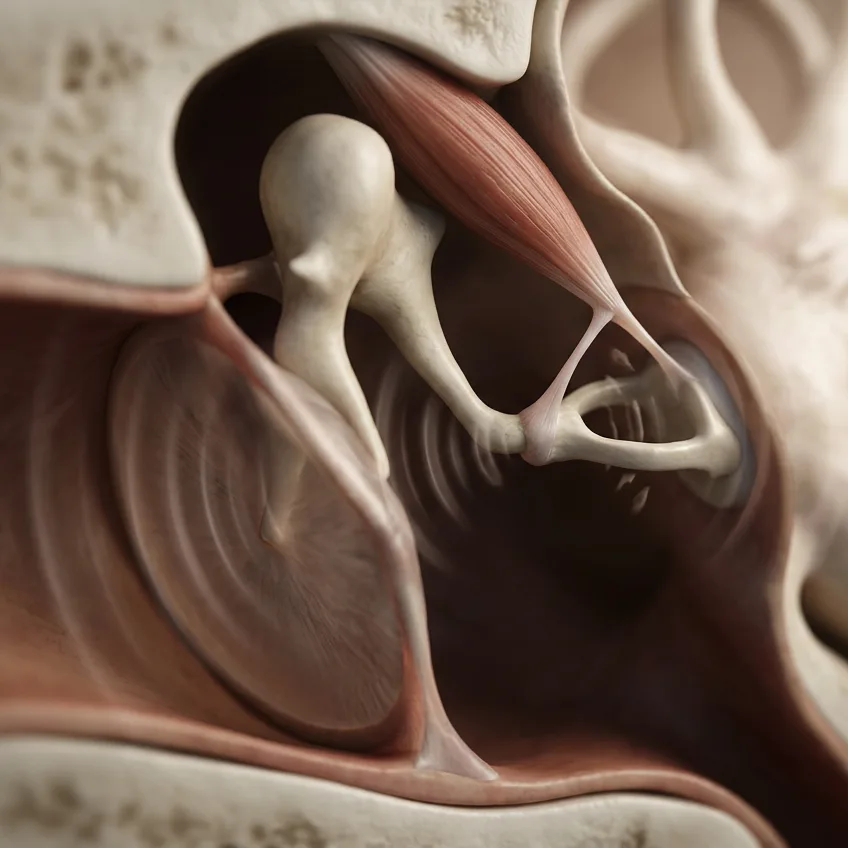
Deep inside the middle ear hides the stapedius muscle, a tiny skeletal fiber barely one millimeter long that holds the record as the smallest muscle in the human body. Despite its almost microscopic scale, it plays a vital role in auditory health known as the stapedial reflex or acoustic reflex.
When the environment exceeds a threshold of between 75 and 85 decibels, this biological spring contracts automatically within an interval of 40 to 100 milliseconds. As it tenses, it pulls on the stapes—the last ossicle in the auditory chain—reducing its contact with the oval window of the cochlea. This mechanical dampening deactivates part of the shock vibration, reducing up to 20 decibels in low frequencies before the wave damages the fragile hair cells of the inner ear.
However, the greatest feat of this micromuscle is not defensive against the outside world, but its impeccable internal coordination:
- Vocal anticipation: Fractions of a second before you utter a shout or a sentence, the brainstem predictively activates the stapedius, attenuating the acoustic transmission of your own vocal cords through the skull.
- Conversational clarity: By filtering out the low-pitched echo of one's own voice and the environment, it helps the brain discriminate the high frequencies essential for understanding other people's speech.
Without this discreet millimeter dampening, the sound of your own breathing, chewing, and speaking would rumble at an unbearable volume inside your head.
Source: Journal of the Association for Research in Otolaryngology (JARO)