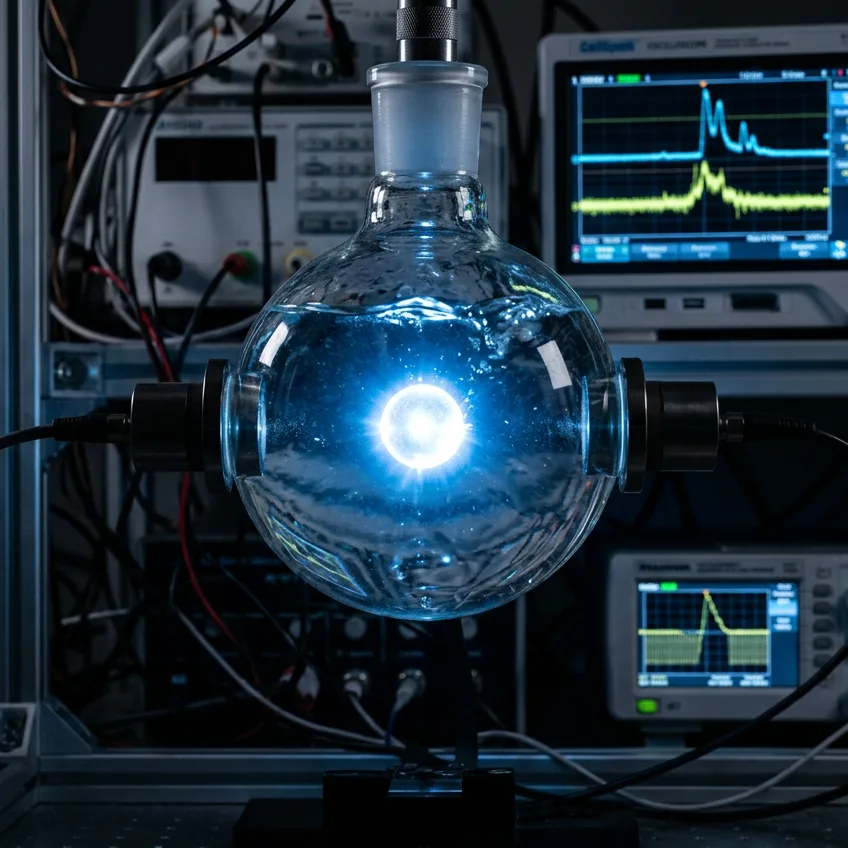
The phenomenon of sonoluminescence is one of the most astonishing oddities in physics, where sound, surprisingly, generates extreme light and heat. Imagine a tiny beam of white light appearing out of nowhere inside a gas bubble, suspended in a liquid and stimulated by sound waves. It is not magic; it is physics at its most enigmatic.
When high-intensity sound waves collapse a bubble in a liquid, it compresses so violently that its gas contents heat up to unimaginable temperatures, estimated in the thousands or even tens of thousands of degrees Celsius, comparable to the surface of the Sun. This ultra-fast collapse and subsequent re-expansion emit a brief, faint flash of light, visible to the naked eye under dark conditions.
Scientists still debate the exact mechanisms behind this extreme heat and light. Some theories suggest that the gas inside the bubble ionizes, forming a plasma that radiates light, or that shock waves forming inside the bubble contribute to the heating. Although the energy generated is minuscule on an individual scale, the phenomenon fascinates because of its ability to concentrate such a large amount of energy into such a tiny point in spacetime.
Sonoluminescence is not just a laboratory curiosity. It is being researched for its potential in fields such as nuclear fusion (if these temperatures could be scaled to sufficient levels), sonochemistry to accelerate chemical reactions, or even in developing new light sources or sterilization methods. This "miniature sun" demonstrates how sound can be a powerful tool, capable of transforming energy in ways we are only beginning to understand.
Source: Scientific American, Nature Physics, Physical Review Letters



