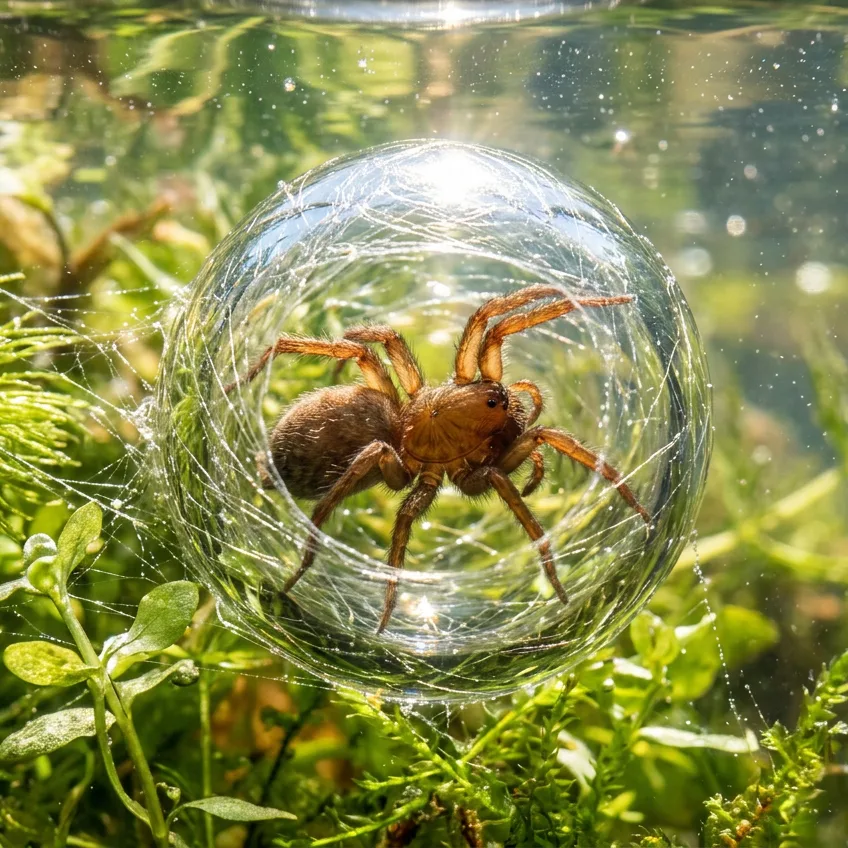
Although arachnids are strictly terrestrial animals that rely on book lungs to breathe atmospheric air, an astounding biological exception exists: the water spider (Argyroneta aquatica). This Eurasian species spends virtually its entire life submerged in ponds and slow-moving streams, where it hunts, sleeps, courts, and cares for its young without ever drowning.
To conquer this environment, the spider weaves a resilient, dome-shaped web among aquatic plants. Next, it pokes its abdomen out of the surface to trap air within its dense hydrophobic hairs and meticulously carries the bubbles down to the bottom, inflating a genuine homemade diving bell. However, its greatest secret lies in the fluid physics governing this structure.
In 2011, researchers Roger Seymour and Stefan Hetz measured the gas exchange of these bubbles using microsensors and discovered that the bell does not act as a mere passive oxygen tank, but as an active physical gill. As the spider breathes and consumes the stored gas, the partial pressure of oxygen inside the dome drops below that of the surrounding water. This gradient forces dissolved oxygen in the water to spontaneously enter the bubble across the contact surface, while carbon dioxide is expelled into the aquatic environment.
Thanks to this ingenious natural mechanism, the bell generates up to ten times more oxygen than it originally held, allowing the animal to remain motionless underwater for more than twenty-four consecutive hours before residual nitrogen loss reduces the volume of its shelter.
Source: Journal of Experimental Biology (Seymour & Hetz, 2011)