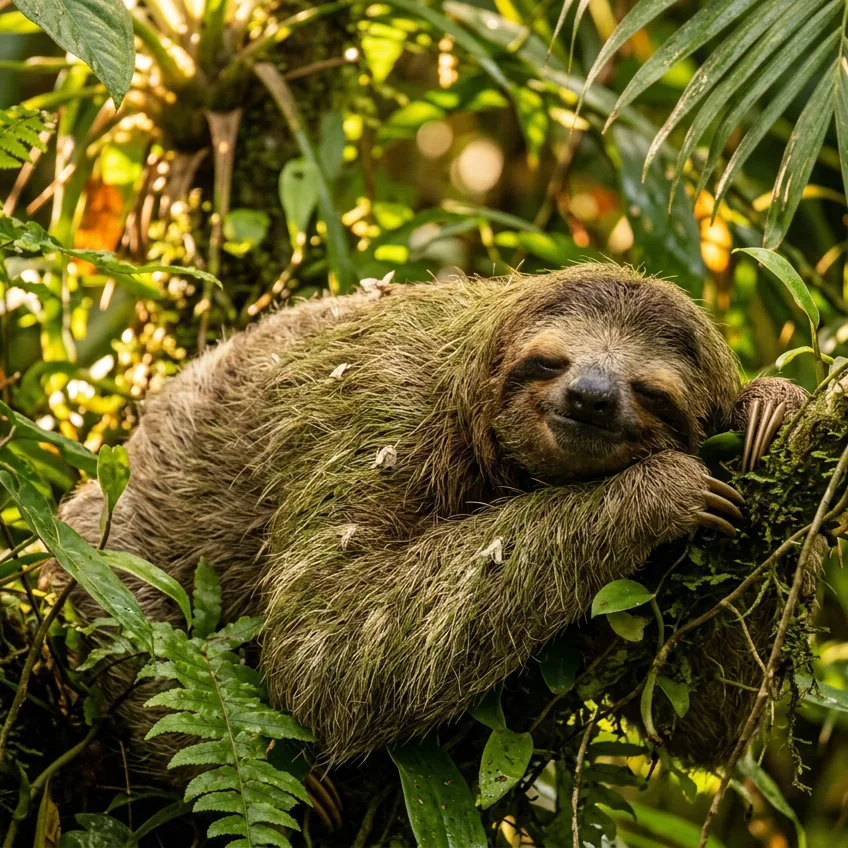
Once a week, the three-toed sloth (Bradypus) leaves the relative safety of the tree canopy to descend to the forest floor for a single purpose: to defecate. This ritual represents an extreme biological puzzle, as more than half of sloth deaths occur precisely during this descent, at the hands of jaguars, ocelots, and harpy eagles. Why does the slowest mammal on the planet risk its life to use the bathroom?
The answer lies in a sophisticated three-way symbiosis that takes place on its body. The sloth's dense fur hosts entire colonies of specialized moths (Cryptoses choloepi) that live nowhere else in the world. When the sloth climbs down to defecate in the leaf litter, female moths take advantage of the stop to lay their eggs in the fresh dung. The larvae grow by feeding on the feces and, once they become adults, fly up into the canopy to colonize a sloth.
When they die in the fur, the moths' bodies decompose and release highly available inorganic nitrogen and phosphorus. This fertilizer nurtures a unique species of green alga (Trichophilus welckeri) adapted to grow exclusively in the microscopic grooves of the mammal's hair. Thanks to this 'walking farm', the sloth gains two crucial advantages:
- Cryptic camouflage: The layer of algae turns its coat a greenish shade that makes it invisible to aerial predators.
- Caloric supplement: The sloth ingests these algae rich in digestible lipids by licking itself during grooming, compensating for an energetically poor diet of dry leaves.
Source: Proceedings of the Royal Society B (Pauli et al., 2014: 'A syndrome of mutualism promotes the lifestyle of the three-toed sloth')