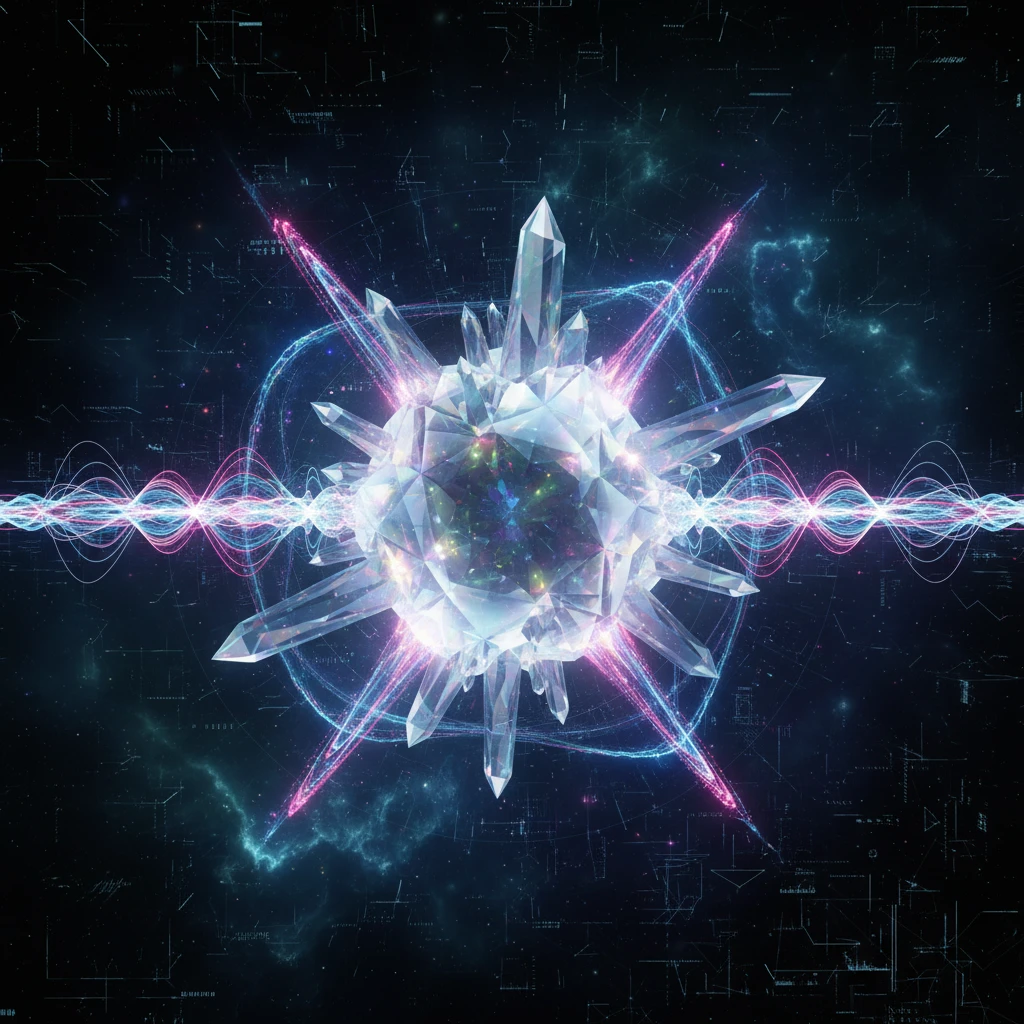
Imagine a crystal that not only has an orderly structure in space, but also in time, repeating a rhythmic pattern perpetually without the need for external energy. This is not science fiction; these are time crystals, a state of matter first proposed in 2012 by Nobel Laureate in Physics Frank Wilczek and observed experimentally in 2017.
Unlike traditional crystals that have a structure that repeats in space (such as an atomic lattice in a diamond), time crystals possess a fundamental periodicity in time. This means that their particles move in a repeating pattern, oscillating from one state to another, even in their ground state of lowest energy, without dissipating heat or requiring a constant drive.
This phenomenon seemingly defies the second law of thermodynamics, but it does so in a non-equilibrium quantum system. Scientists have managed to create these time crystals using ytterbium ion chains and defects in diamonds, observing how their quantum states oscillate at their own rhythm, which is twice the period of the pulse that 'drives' them.
The implications of this new phase of matter are profound. They could serve as stable building blocks for future quantum computers, offering a new way to store and process information with unprecedented reliability. In addition, their temporal precision could open doors to ultra-sensitive sensors and even more exact atomic clocks, revolutionizing fields from navigation to fundamental physics.
Source: Nature, Physical Review Letters, MIT News