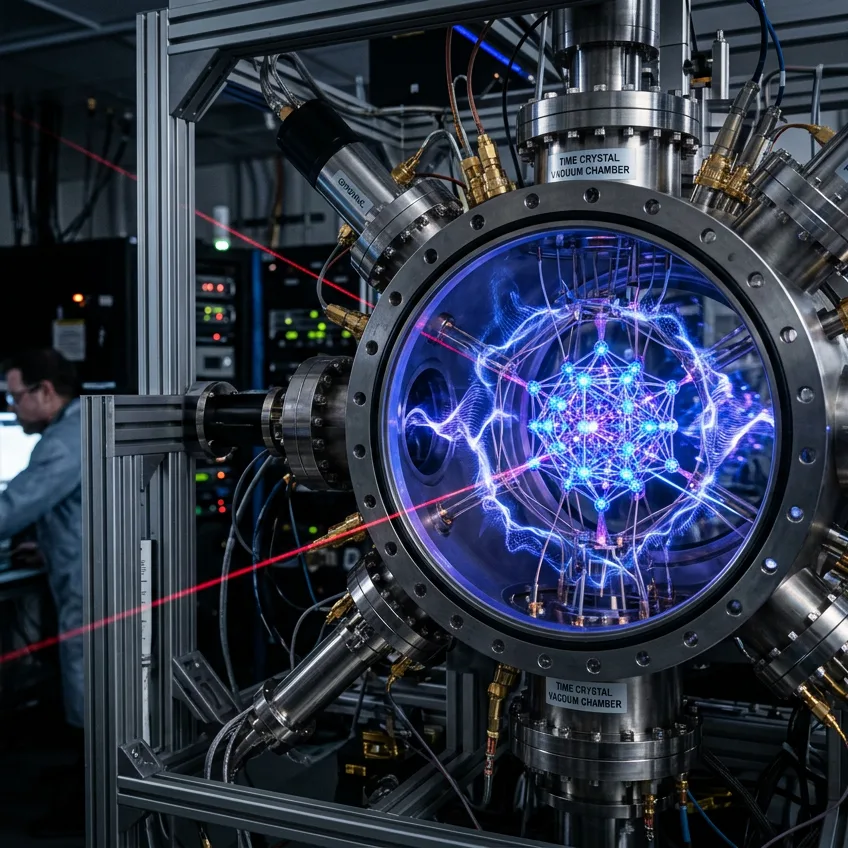
In traditional physics, an ordinary crystal, like a diamond or a grain of salt, is an ordered structure where atoms repeat periodically throughout three-dimensional space. However, in 2012, Nobel laureate Frank Wilczek posed a bold hypothesis: could a state of matter exist whose components repeat not in space, but in time?
Thus was born the concept of time crystals, a phase of matter that did not achieve experimental validation until 2017 in laboratories at the University of Maryland and Harvard. Unlike any known object that reaches an unchanging thermal rest, the atoms of a time crystal oscillate perpetually and rhythmically between different configurations, even while in their ground state of lowest energy.
Although at first glance this behavior is reminiscent of a perpetual motion machine, it does not violate the laws of thermodynamics:
- No useful work: The system does not generate energy that can be extracted, nor does it dissipate heat to the outside; it simply remains trapped in a self-sustained quantum dance.
- Symmetry breaking: It breaks discrete time-translation symmetry, responding to stimuli at a different frequency than the one applied to it.
In 2021, researchers at Google Quantum AI managed to recreate a time crystal using 20 superconducting qubits inside their Sycamore processor. This milestone not only confirmed a new frontier in non-equilibrium physics, but it also opened the door to the development of ultra-robust quantum memories, immune to the thermal disturbances that threaten the computers of the future.
Source: Nature (article on the observation of discrete time crystals in quantum processors, Google Quantum AI, 2021)