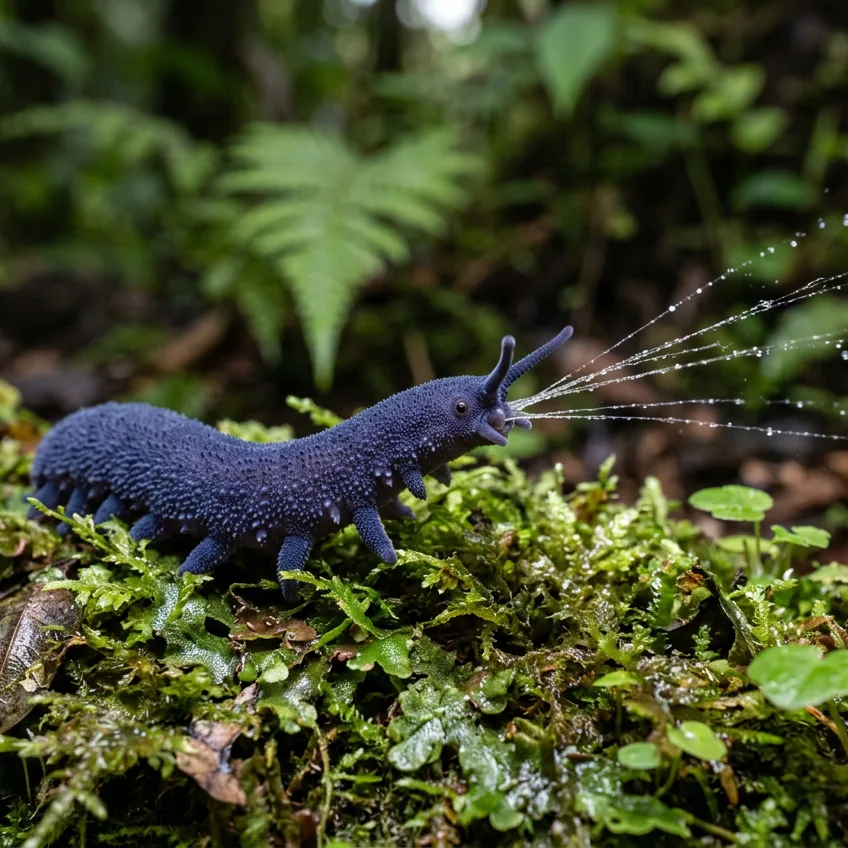
In the humid understory of the tropics lives the velvet worm (phylum Onychophora), a living fossil whose anatomy has barely changed in five hundred million years. Despite its slow movement and soft body, it is a relentless hunter equipped with one of the most sophisticated biomechanical weapons in nature: a pair of oral cannons capable of shooting jets of sticky slime across distances of more than thirty centimeters in a fraction of a second.
For decades, biologists believed the worm actively shook its head or used muscular microfrequencies to spray its prey. However, biophysical studies from Harvard University and the Universidad de Chile revealed a far more astonishing phenomenon: the worm expends no muscular energy on the sweep. By contracting its internal reservoir, it expels liquid under such pressure through its elastic papillae that it triggers an elasto-hydrodynamic instability. The nozzles enter a passive, perfect oscillation of between thirty and sixty hertz, weaving a crisscrossed net that snares the target immediately.
The properties of this secretion are just as extraordinary:
- Tensile polymerization: The fluid consists of water, lipids, and disordered proteins; when prey struggles, the mechanical shear force breaks the aqueous bonds and instantly condenses the proteins into solid fibers as tough as nylon.
- Ballistic efficiency: By passively weaving a zigzag net, it covers an area dozens of times larger than with a straight jet.
Once the victim is immobilized, the worm pierces its cuticle, injects digestive enzymes, and devours the liquefied prey along with its own slime, recycling valuable amino acids.
Source: Nature Communications (Concha et al., 2015: 'Onychophoran slime jetting is an elasto-hydrodynamic instability')