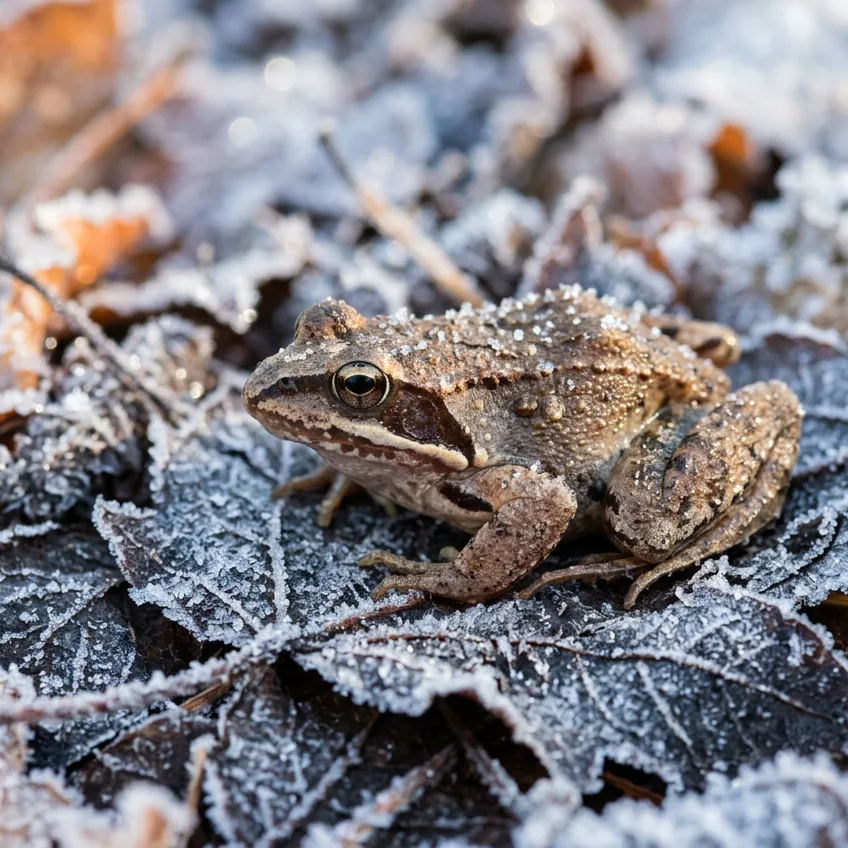
In the boreal forests of Alaska and Canada, the wood frog (Lithobates sylvaticus) defies the laws of clinical death every winter. While other animals migrate or burrow beneath the frost line, this species takes shelter just under the leaf litter, tolerating temperatures down to -16 °C. When severe cold hits, its body literally freezes: its eyes turn white, its lungs cease breathing, and its heart stops beating entirely for weeks or months.
The secret behind this apparent resurrection lies in an astonishing biochemical strategy:
- Natural glucose-based antifreeze: As soon as the first ice crystals touch its skin, its liver rapidly converts glycogen reserves into pure glucose, spiking blood levels up to 300 times above normal.
- Intracellular protection: This surge of sugar and urea does not prevent water from freezing, but it confines ice formation entirely to the outside of the cells. The cell interior dehydrates in a controlled and concentrated manner, preventing sharp ice crystals from tearing biological membranes.
- Reversible vital cessation: Up to 65-70 % of total body water turns into solid ice. There is no pulse and no measurable brain activity.
When spring arrives, thawing occurs from the inside out. Within a few hours, the heart spontaneously resumes beating without any external electrical stimulus, blood circulation restarts, and the frog hops away in search of a mate as if no time had passed. Studying this species is now one of medicine's greatest hopes for revolutionizing the preservation of human organs for transplants.
Source: Journal of Experimental Biology