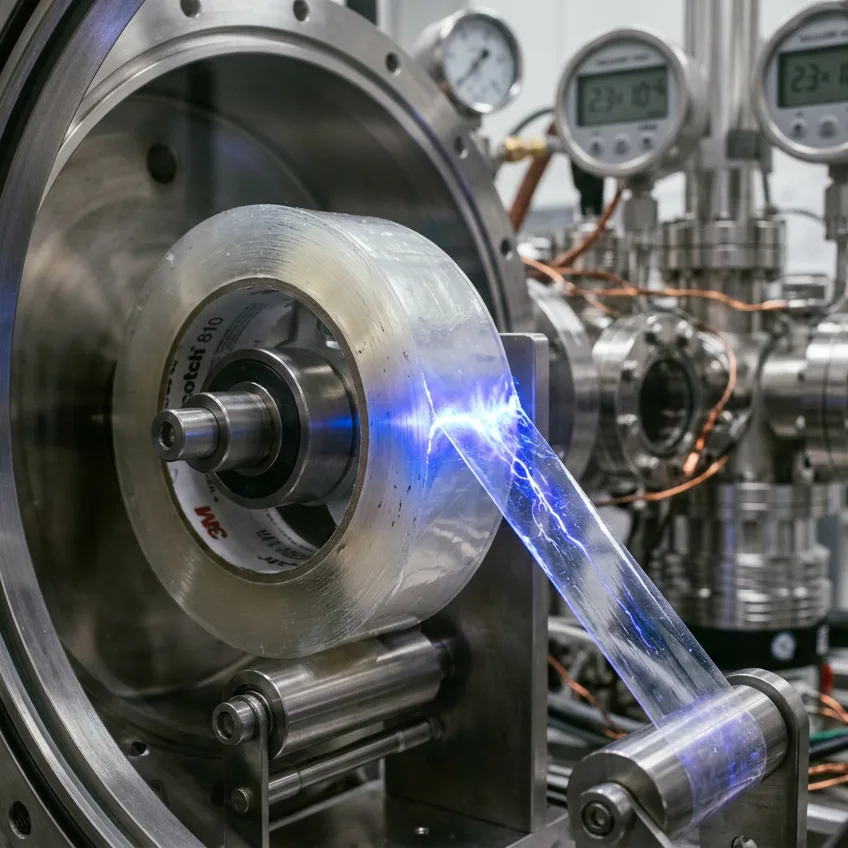
In 1953, Soviet scientists observed the first hints that peeling adhesive tape generated unusual electromagnetic radiation. However, it was not until 2008 that physicists from the University of California, Los Angeles (UCLA) astonished the scientific community: by unrolling conventional adhesive tape inside a vacuum chamber at three centimeters per second, the system produced bursts of X-rays powerful enough to capture a clear radiograph of a researcher's finger.
The principle behind this phenomenon is triboluminescence, a physical process in which breaking chemical bonds and mechanically separating materials generate intense electrical charges. When the acrylic adhesive is abruptly separated from the polyethylene backing, a massive potential difference forms across a fraction of a millimeter. Jumping across the vacuum, electrons accelerate at extreme speeds toward the positive surface, and when colliding with it, they release their energy as high-energy photons through braking radiation or Bremsstrahlung.
In the presence of normal atmospheric air, this collision is cushioned by gas molecules, producing only a faint blue glow visible in the dark. However, under vacuum conditions, the process reaches medical energy levels. This finding showed that complex accelerators or radioactive sources are not required to generate radiographic pulses, inspiring the development of portable, inexpensive, and safe X-ray devices for disaster zones or future space missions.
Source: Nature journal (Camara, C. G. et al., 2008: 'Correlation between nanosecond X-ray flashes and stick-slip friction in peeling tape')