For centuries, the greatest enemy of astronomers was not the vastness of the cosmos, but our own atmosphere. Thermal air turbulence constantly deflects and agitates cosmic light rays, causing stars to twinkle and blurring images from ground-based telescopes. The solution to this dilemma came with one of the greatest feats of physical engineering: adaptive optics.
To correct the sky's distortion live, major observatories execute a sophisticated cycle that occurs in milliseconds:
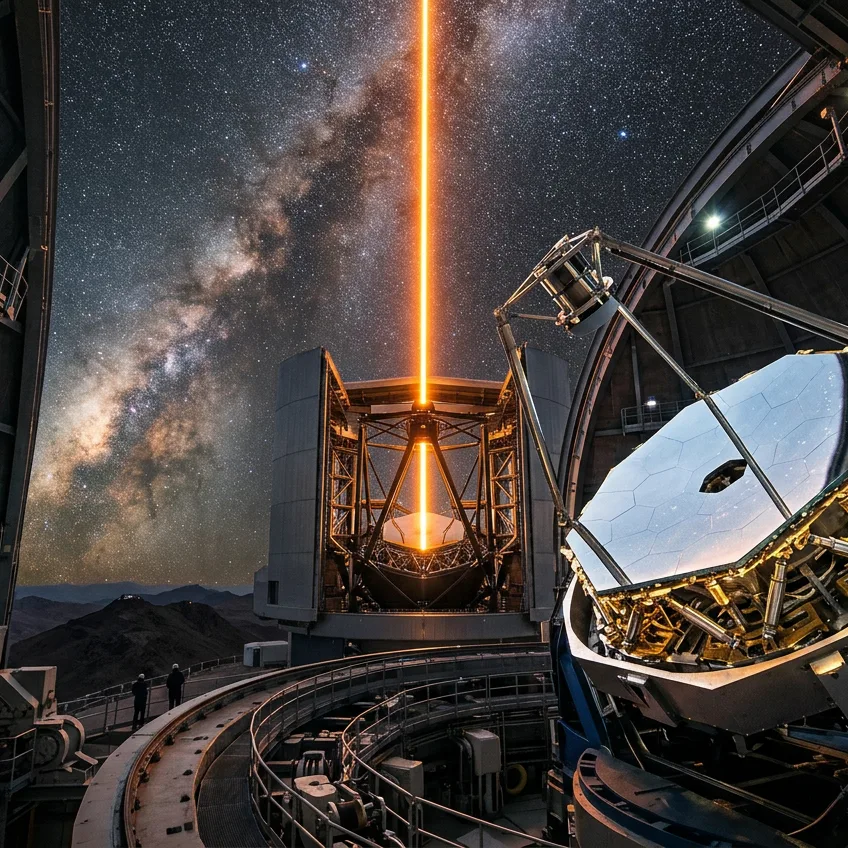
- Laser guide star: The observatory projects a powerful laser beam into Earth's mesosphere (at an altitude of about 90 kilometers), ionizing a thin layer of sodium atoms to create an "artificial star" with a known position and brightness.
- Wavefront sensor: A very high-speed camera measures exactly how air turbulence deforms the light from that artificial star up to a thousand times per second.
- Deformable mirror: A supercomputer instantly calculates the aberration and sends commands to a flexible mirror, often barely one or two millimeters thick, supported by an array of hundreds or thousands of piezoelectric actuators.
These tiny pistons push and bend the glass with nanometric precision, adopting a shape millimetrically opposite to the ripples that the atmosphere caused in the light. Thanks to this technological miracle, ground-based giants like the Very Large Telescope (VLT) obtain deep-universe images with an angular resolution that directly rivals that of the Hubble Space Telescope.
Source: European Southern Observatory (ESO)