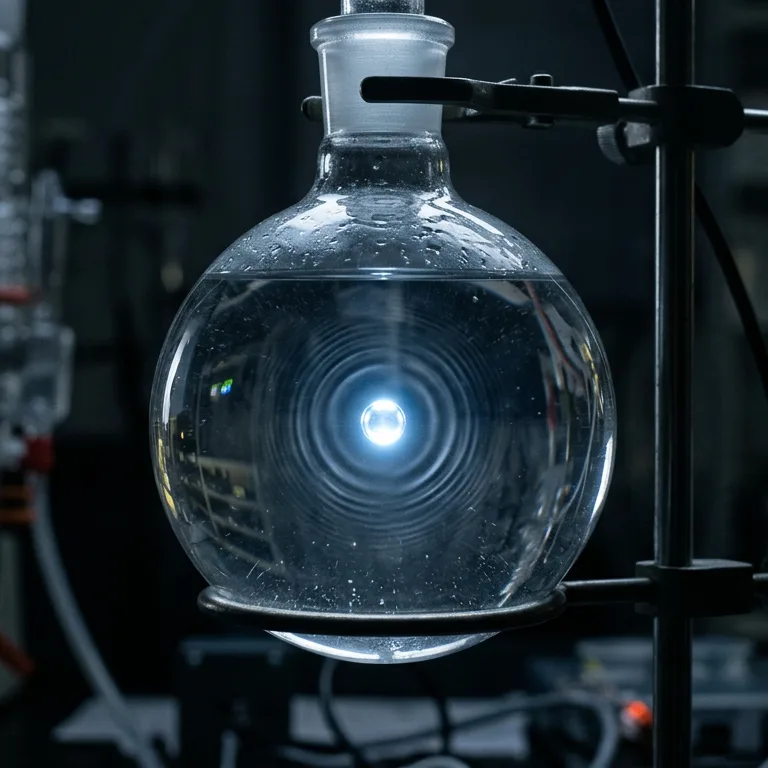
In 1934, physicists H. Frenzel and H. Schultes discovered an effect so baffling that for decades it bordered the limits of theoretical physics: sonoluminescence. By subjecting a flask filled with water to powerful ultrasound waves, they observed that the acoustic field trapped tiny gas bubbles and caused them to oscillate. The amazing part happened during the compression phase: the bubble imploded with such violence that it emitted a visible flash of light.
This phenomenon, colloquially known as creating a "star in a jar", converts diffuse acoustic energy into a colossal energy density. During the collapse, the walls of the microbubble travel toward the center at supersonic speeds, compressing the trapped gas into a minuscule volume.
Spectrometric analyses have revealed extreme physical parameters:
- Astounding temperatures: The core of the bubble reaches between 10,000 °C and over 20,000 °C, far surpassing the surface of the Sun, which is around 5,500 °C.
- Ultrafast pulses: The light flashes last between 30 and a few hundred picoseconds, generated under pressures of millions of atmospheres.
- Plasma creation: The extreme conditions strip electrons from the atoms of dissolved noble gases (such as argon), generating a transient incandescent plasma state.
Today, sonoluminescence remains one of the most fascinating experimental frontiers in the study of fluid physics and quantum hydrodynamics.
Source: Physical Review Letters / Nature - Acoustics and Sonoluminescence Research