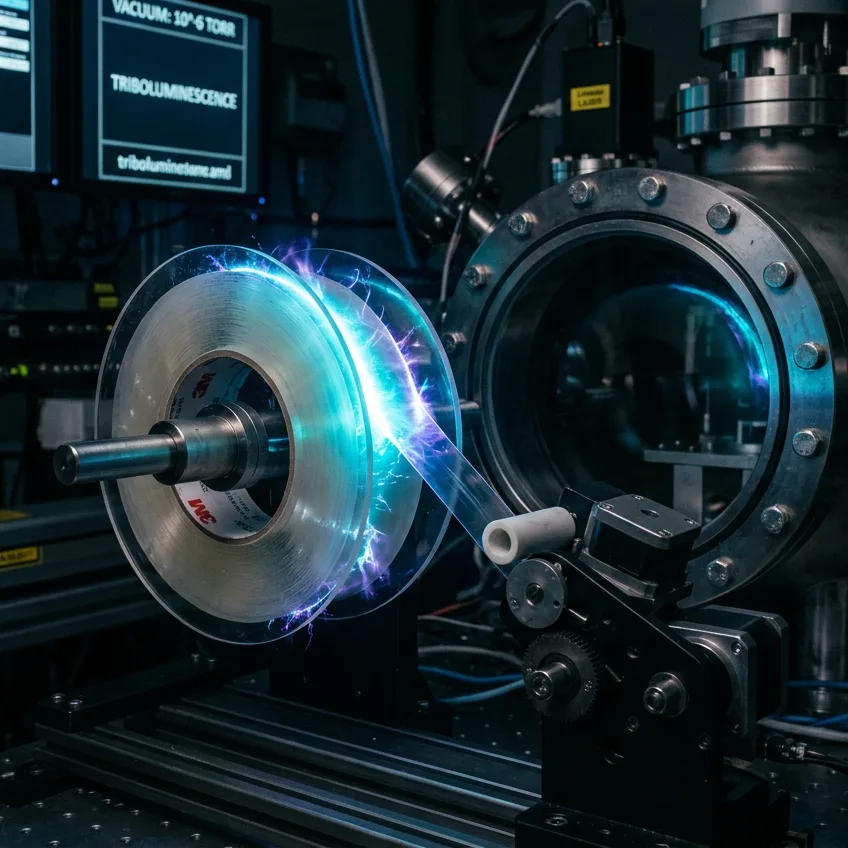
In 2008, a team of physicists at the University of California, Los Angeles (UCLA) amazed the world by confirming an almost unbelievable phenomenon: unrolling ordinary adhesive tape inside a vacuum chamber generates enough X-ray emission to take a clear X-ray of a human finger bone.
This process is based on triboluminescence, the emission of photons caused by mechanical fracture or tearing of molecular bonds. By violently separating the acrylic adhesive from the polyethylene backing, millions of electrons are ripped away and build up on one of the surfaces:
- The crucial role of the vacuum: Under normal ambient conditions, these electrons immediately collide with air molecules and dissipate as faint sparks invisible to the naked eye. In a vacuum, with no molecules to slow them down, the electrons accelerate to dizzying speeds.
- Bremsstrahlung radiation: When this avalanche of electrons strikes the positive side of the roll, they decelerate instantly, converting their kinetic energy into braking radiation or Bremsstrahlung, the exact physical mechanism operating inside medical X-ray tubes.
- High-energy pulses: Unrolling the tape at just three centimeters per second, the physicists recorded 15-kilovolt X-ray bursts in pulses lasting mere billionths of a second.
The discovery showed that a cheap household item can be turned into a controlled radiation source without needing radioactive materials or complex high-voltage power supplies.
Source: Nature journal (Camara et al., 2008: 'Correlation between nanosecond X-ray flashes and stick-slip friction in peeling tape')