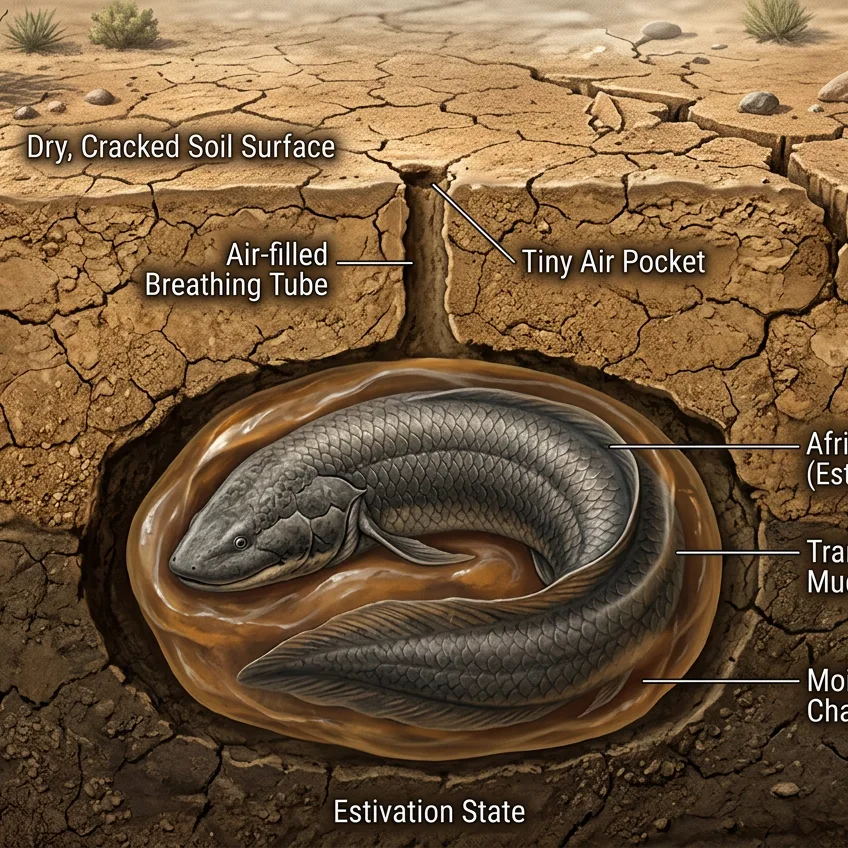
In the floodplains of sub-Saharan Africa, seasonal droughts can turn marshes teeming with life into cracked, arid earth. While most aquatic creatures perish or flee, the African lungfish (Protopterus annectens) performs one of the most astonishing survival tricks in the animal kingdom: it buries itself alive and waits for the rain for years.
Unlike most fish, this species has fully functional primitive lungs and reduced gills, which forces it to breathe air at the surface. When the water begins to evaporate completely, the fish digs a vertical burrow into the soft mud using its mouth, reaching depths of up to 25 centimeters. Once settled at the bottom, it secretes a dense layer of mucus over its entire skin that, upon drying, forms a waterproof cocoon similar to parchment, leaving only a tiny opening connected to the outside to breathe.
In this state of extreme estivation, its physiology changes completely:
- Slowed metabolism: It reduces its energy consumption to just a fraction of normal, slowing its heartbeat.
- Waste management: It stops producing toxic ammonia and stores concentrated urea in its tissues without poisoning itself.
- Controlled self-consumption: It slowly breaks down proteins from its own muscle mass for energy, keeping its vital organs intact.
Scientists have verified that these fish can remain in suspended animation for between three and five years without eating a bite or drinking a single drop of water. When the torrential rains of the wet season finally flood the land, the dried mucus cocoon dissolves, the fish wakes up, and it swims out as if no time had passed.
Source: Journal of Experimental Biology / Smithsonian National Zoo