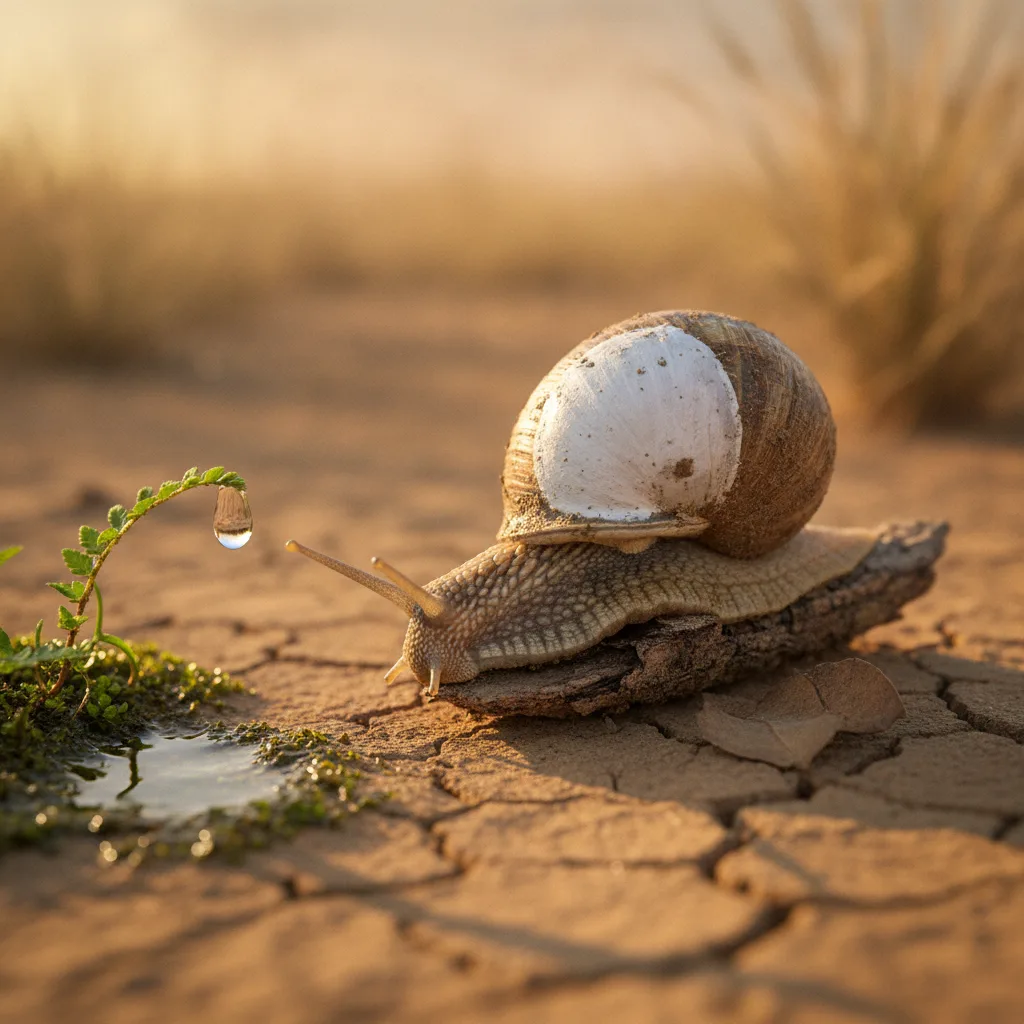
The common garden snail (Helix aspersa) possesses a survival ability that seems straight out of science fiction: it can enter a state of suspended animation called estivation for up to 3 years, without food or water.
When conditions become extremely dry, the snail secretes a layer of mucus that hardens to form an airtight seal called an epiphragm over the opening of its shell. This calcium carbonate seal reduces water loss to less than 1% annually, allowing it to maintain its metabolism at 0.01% of its normal level.
A study from the University of Bristol (2019) showed that during estivation, the snail reuses waste products from its own metabolism to synthesize protective molecules that prevent cellular damage. Its heart beats barely once every 24 hours and its nervous system reorganizes to preserve essential neural connections.
When moisture returns, the epiphragm dissolves in less than 30 minutes, and the snail fully revives in 2-3 hours, ready to reproduce immediately. This adaptation has allowed it to colonize environments ranging from deserts to temperate forests, making it one of the most successful survivors on the planet.
Source: Study by the University of Bristol on estivation in gastropods (2019), Journal of Experimental Biology