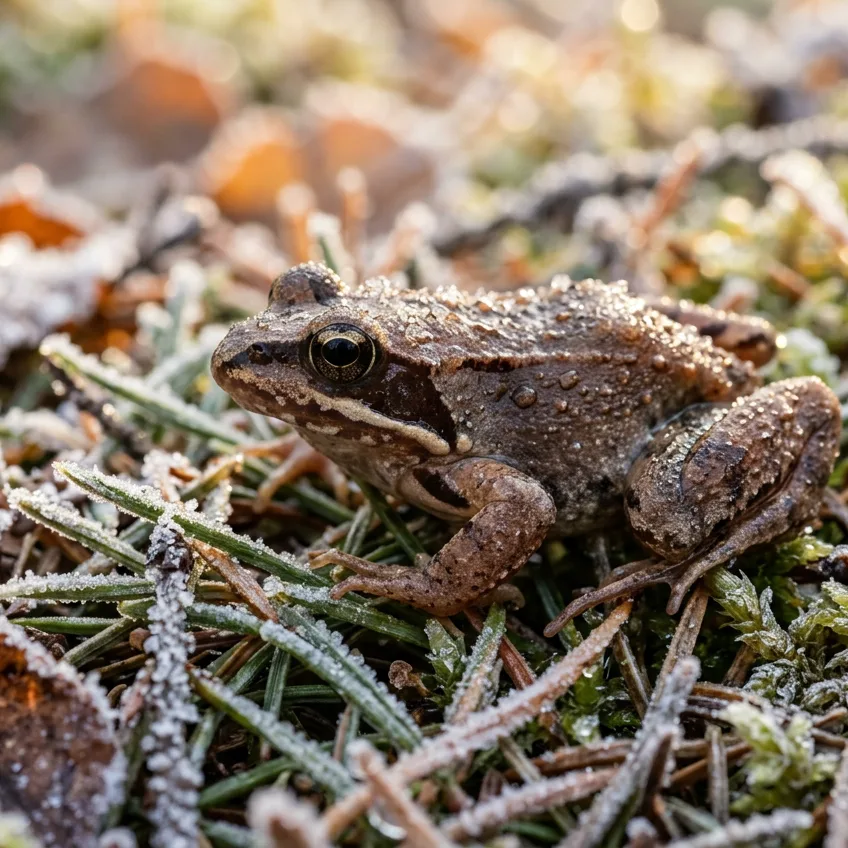
In the boreal forests of Alaska and Canada lives one of the greatest wonders of cryobiology: the wood frog (Lithobates sylvaticus). While freezing destroys the cell membranes of almost any vertebrate, this amphibian survives extreme temperatures as low as -18 °C by literally turning into a frozen stone.
The mechanism triggers as soon as the first ice crystals touch its skin. In a matter of minutes, the frog's liver massively breaks down its glycogen reserves and releases colossal amounts of glucose into the bloodstream, multiplying its baseline levels by more than two hundred times. This massive concentration of sugar, combined with urea retained in its tissues, acts as a potent intracellular antifreeze.
Ice forms in a controlled manner in extracellular spaces, inside the abdominal cavity, and beneath the skin, but the inside of the cells remains intact and dehydrated thanks to the osmotic pressure of glucose. During the harshest point of winter, up to 65 % of the water in its body freezes. Its eyes turn opaque, its lungs cease ventilation, the brain shuts down any detectable signals, and its heart stops beating completely.
When temperatures rise in spring, the animal thaws from the inside out. In a matter of hours, the heart spontaneously resumes its contractions without suffering tissue damage, circulation is restored, and the frog hops toward the nearest pond to breed without any lasting effects.
Source: Journal of Experimental Biology