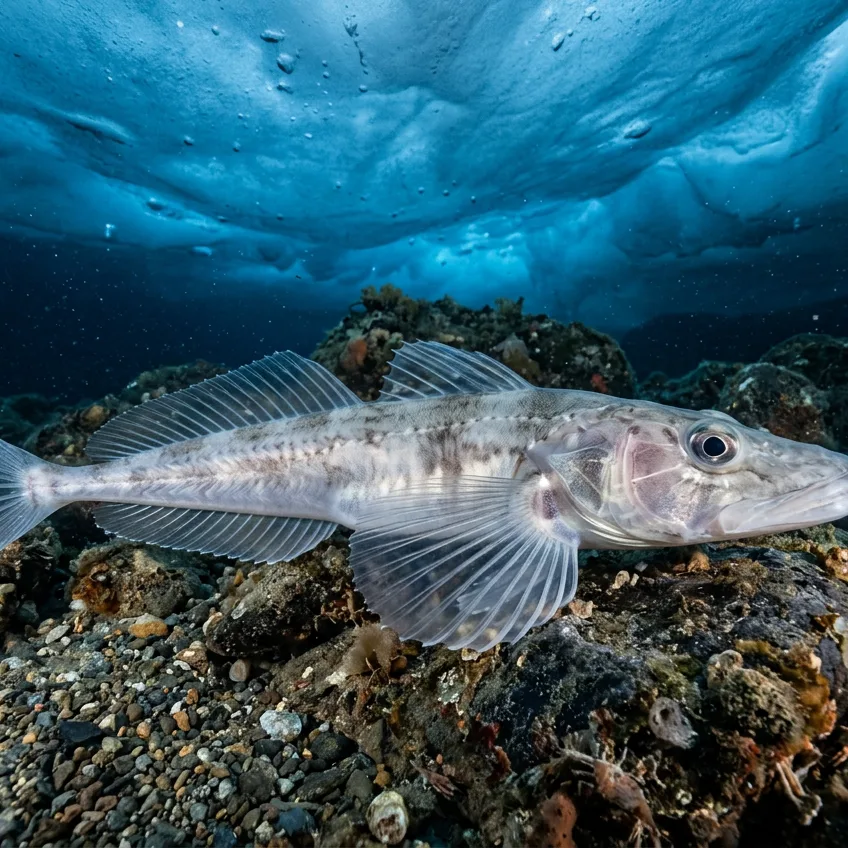
In the frigid depths of the Southern Ocean, where water temperatures drop to -1.9 °C (below the freezing point of fresh water), lives one of biology's most puzzling creatures: the Antarctic icefish (family Channichthyidae). It is the only known vertebrate on Earth that completely lacks functional hemoglobin and mature red blood cells in its bloodstream, making its blood entirely translucent, resembling seawater.
In any other vertebrate, the absence of hemoglobin would cause fatal suffocation within minutes. However, the icefish turned a seemingly limiting mutation into a masterclass in evolutionary adaptation through extreme adjustments:
- Oxygen dissolved in plasma: Because icy Antarctic water retains extremely high gas concentrations, oxygen dissolves directly into its blood plasma without the need for cellular carriers.
- An oversized heart: It possesses a colossal circulatory system, with a heart up to four times larger and capillaries much wider than those of other fish of similar size, pumping large volumes of fluid at low pressure.
- Biological antifreeze: Its body synthesizes antifreeze glycoproteins that bind to ice microcrystals in its tissues, preventing them from growing and tearing its cells.
By eliminating red blood cells, its blood loses viscosity in near-freezing water, reducing friction in its vessels and saving an immense amount of metabolic energy to thrive where almost nothing else survives.
Source: British Antarctic Survey / Proceedings of the National Academy of Sciences (PNAS)