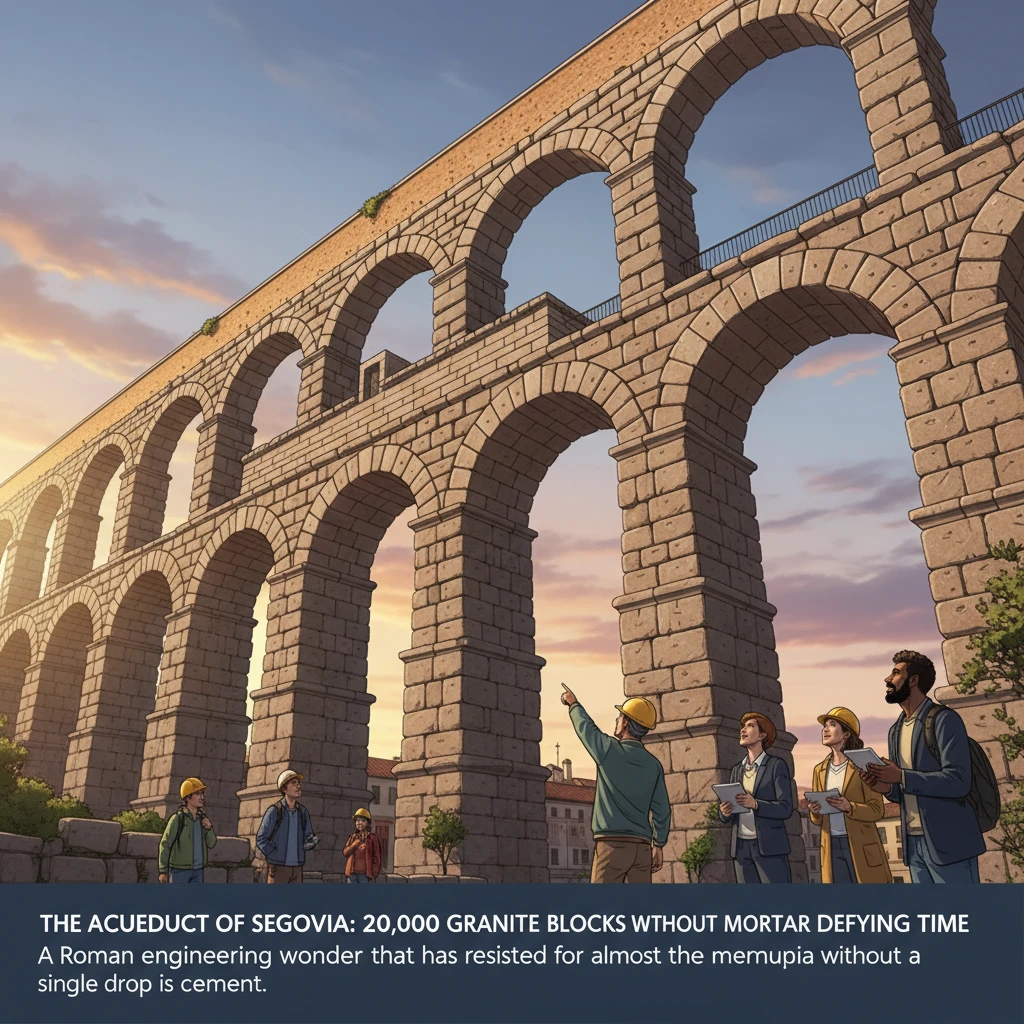
The Aqueduct of Segovia, in Spain, is one of the best-preserved monuments of Roman engineering. Its construction, dating from the 1st to the 2nd century AD, presents an astonishing fact: it consists of approximately 20,400 blocks of gray granite joined together without using any mortar or binding agent.
The structure stands solely through the precision of the stone cutting and the perfect distribution of compressive forces. With a length of 818 meters and a maximum height of 28 meters at the Plaza del Azoguejo, this hydraulic work transported water from the Frío River to the city.
- Cement-free engineering: Stability is achieved through a system of arches and voussoirs calculated with extraordinary mathematical precision.
- Historical resilience: It has survived wars, earthquakes, and the erosion of centuries, proving the superiority of its structural design.
- Original operation: The upper canal, lined with hydraulic mortar (opus signinum), allowed a constant flow of water by gravity.
This engineering colossus was declared a UNESCO World Heritage Site in 1997 and remains a symbol of human ingenuity in building durable and functional infrastructure.
Source: UNESCO - World Heritage: Aqueduct of Segovia. Real Academia de la Historia: Roman engineering in Hispania.