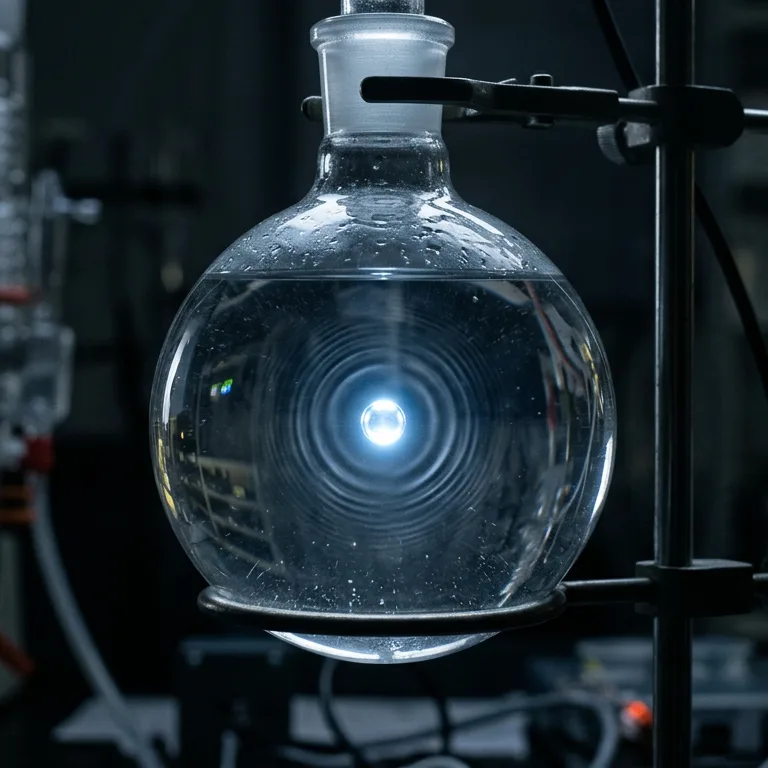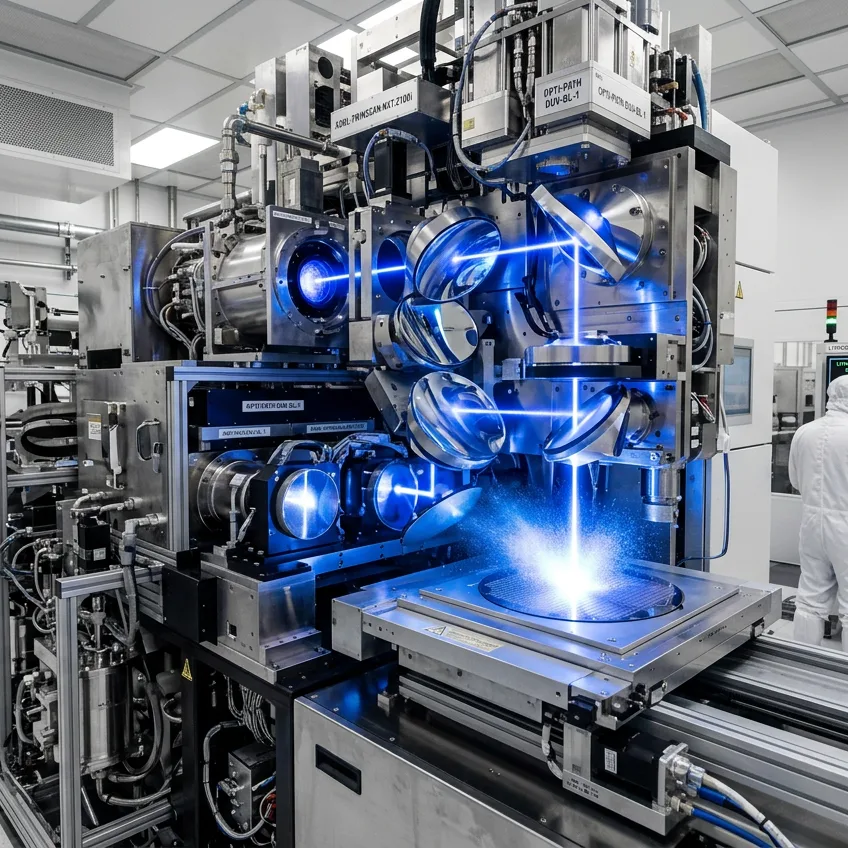
At the heart of every cutting-edge microchip found in smartphones or artificial intelligence data centers lies a machine bordering on the limits of physics: the extreme ultraviolet (EUV) lithography system manufactured exclusively by the Dutch company ASML.
To draw transistors measuring just a few nanometers, visible or conventional ultraviolet light is too thick. The solution was to generate EUV light with a wavelength of just 13.5 nanometers, but creating that light stably required an unprecedented technical marvel:
- Tin droplet generator: A generator ejects fifty thousand microscopic droplets of molten tin per second at about three hundred kilometers per hour in a vacuum chamber.
- Double laser pulse: A very high-power carbon dioxide laser fires twice at each droplet. The first pulse flattens it into a disc shape, and the second vaporizes it instantly, turning it into a blazing plasma at more than 200,000 °C that emits EUV photons.
- The smoothest mirrors in the world: Since air and glass absorb this radiation, the light is not focused with lenses, but with ultra-polished mirrors developed by Zeiss. If these reflectors were the size of all of Germany, their highest bump would not exceed one millimeter.
Composed of more than one hundred thousand parts and weighing over one hundred and eighty tons, this machine coordinates beams of light and mechanical components at supersonic speeds with picometer precision, making it possible to fit more than fifty billion transistors onto a single fingernail.
Source: ASML Technology Insights / IEEE Spectrum