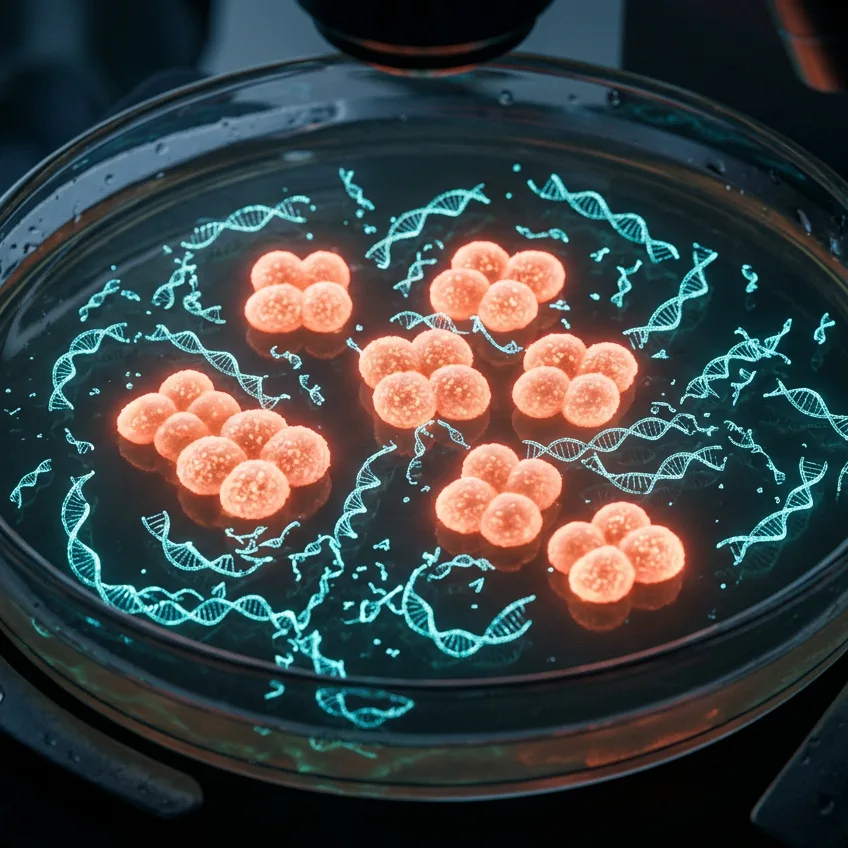
In 1956, a group of scientists in Oregon attempted to sterilize cans of minced meat using massive doses of gamma radiation. Every known living organism should have perished, but the food spoiled anyway. From those samples, they isolated a reddish, spherical bacterium named Deinococcus radiodurans, later dubbed "Conan the Bacterium" by biologists.
While a dose of just 5 to 10 Gray is fatal to a human and 2,000 Gray destroys most bacteria, this microorganism survives more than 15,000 Gray unfazed. Such punishment shatters cellular DNA into hundreds of scattered fragments. However, in a matter of 12 to 24 hours, the bacterium manages to reconstruct its complete genome without errors and reproduce again.
Its secret does not lie in an impenetrable physical shield, but in a masterful combination of biochemistry and genetic redundancy:
- Backup copies: It maintains four to ten identical copies of its genome aligned in dense compartments, allowing intact fragments to serve as templates.
- Manganese enzymatic shielding: It accumulates manganese and peptide complexes that absorb free radicals caused by radiation, protecting protein-repair enzymes.
- Recombinational repair: Its RecA enzymes stitch together pieces of genetic material through a sophisticated guided homologous assembly process.
Scientists believe this astonishing resistance did not evolve to withstand radioactivity, which does not exist at such levels in nature, but as an adaptive shield to survive extreme periods of cellular desiccation, a process that breaks DNA in an identical way.
Source: Nature Reviews Microbiology / Guinness World Records