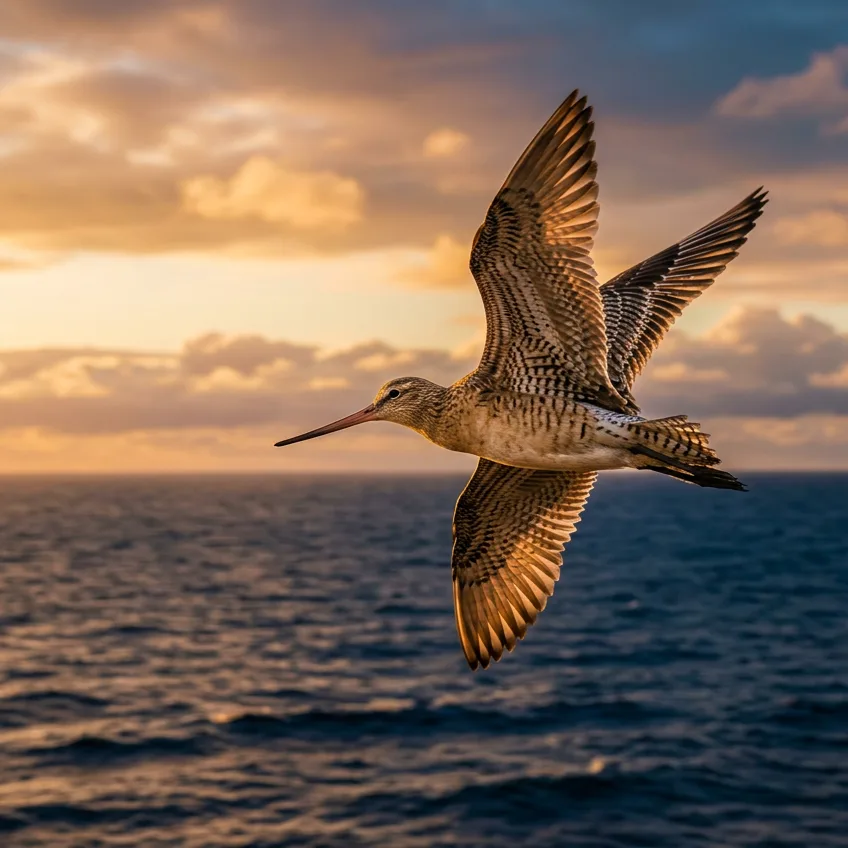
Imagining a nonstop flight of more than 13,000 kilometers over open ocean sounds like a feat reserved for modern aeronautical technology. However, a bird weighing about 300 grams achieves it every autumn: the bar-tailed godwit (Limosa lapponica). In 2022, a juvenile tracked by satellite shattered records by flying for 11 uninterrupted days from Alaska to Tasmania, without landing a single time.
To overcome such a physical trial in an environment where no fresh water or food is available, the animal resorts to unparalleled anatomical transformations:
- Extreme energy loading: Weeks before takeoff, it doubles its body weight by accumulating lipids, turning its body into a living fuel tank.
- Selective organ atrophy: Since it will not consume food, it cuts the size of its stomach, liver, and intestines in half, reducing its overall weight and redirecting all oxygen flow to the pectoral muscles and heart.
- Metabolic water: During the journey, it metabolizes fat and gradually consumes nonessential muscle fibers, a chemical process that releases internal water vapor and prevents lethal dehydration.
Scientists have confirmed that these birds can use unihemispheric sleep, shutting down half of their brain for intervals of just a few seconds to rest without interrupting their flapping. Guided by magnetic receptors and trade winds, they hold the absolute record for aerodynamic endurance on Earth.
Source: Max Planck Institute of Animal Behavior & Guinness World Records (Tracking data 2022)