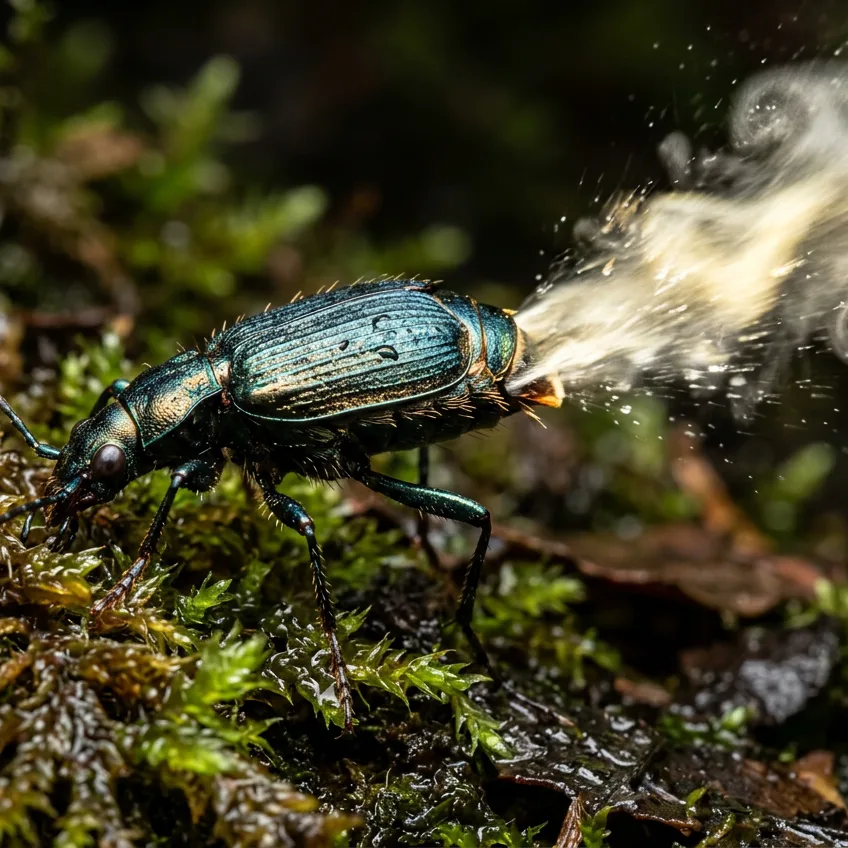
The bombardier beetle (belonging to the tribe Brachinini) possesses one of the most astonishing biological defense systems on the planet: a genuine internal chemical reactor capable of spraying attackers with a caustic jet at 100 °C.
To avoid scalding itself alive, the insect stores two relatively inert chemicals separately: hydrogen peroxide and hydroquinones. When an ant, a toad, or a bird threatens it, the beetle contracts muscular sphincters that force both fluids into a reaction chamber reinforced with thick cuticle. Specialized enzymes (catalases and peroxidases) wait in that compartment.
The contact unleashes a violently exothermic chain reaction:
- Chemical oxidation: The hydroquinones instantly oxidize into p-benzoquinones, a compound that is extremely irritating to ocular and respiratory tissues.
- Steam propulsion: The huge amount of heat released brings the water to its boiling point, generating a sudden steam overpressure that shoots the toxic liquid through a mobile anal nozzle steerable in 360 degrees.
- Pulsed discharge: MIT researchers discovered via synchrotron X-rays that the jet is not continuous, but occurs in micro-explosions of up to 735 pulses per second. This cyclic vibration cools the chamber between detonations, preventing the insect from damaging its own abdomen.
The efficiency of this biological ballistic spray has inspired aerospace engineers in the design of fuel injectors for turbines and pump-free microtechnical fire suppression systems.
Source: Science / Proceedings of the National Academy of Sciences (PNAS)