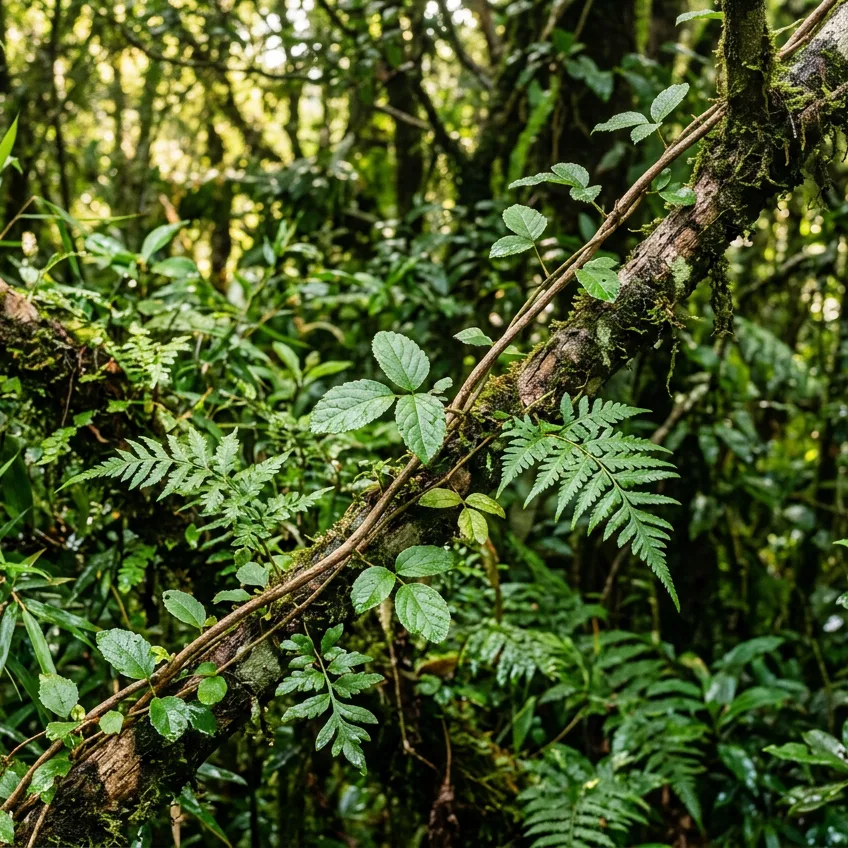
In the plant kingdom, many species rely on chemical defenses or spines to avoid being eaten. However, the vine Boquila trifoliolata, native to the temperate rainforests of Chile and Argentina, possesses an ability so unusual that it challenges modern botany: it can alter the shape, size, texture, and even the color of its leaves to imitate its neighboring plant with astonishing accuracy.
Unlike other known cases of biological camouflage, this species does not rely on a single genetic disguise. Along the very same branch, Boquila can successively alter the design of its leaves to copy different trees as it climbs toward the forest canopy. Among the traits it manages to transform are:
- Morphology and margin: it replicates smooth, toothed, or lanceolate leaves depending on the pattern of the host tree.
- Pigmentation: it adapts the shade of green, vein patterns, and even reddish hues to go unnoticed.
- Leaf thickness: it modulates the blade thickness to emulate leathery or delicate leaves.
The mystery deepened when scientific studies showed that the vine successfully copied the silhouette of artificial plastic leaves placed in its surroundings, without physical contact or the exchange of chemical or microbial substances. This unusual behavior has revived the "plant ocelli" hypothesis proposed by Francis Darwin in 1905, suggesting that plant epidermal cells might function as rudimentary optical lenses capable of perceiving basic images of their environment.
Source: Current Biology (Gianoli & Carrasco-Urra) / Plant Signaling & Behavior