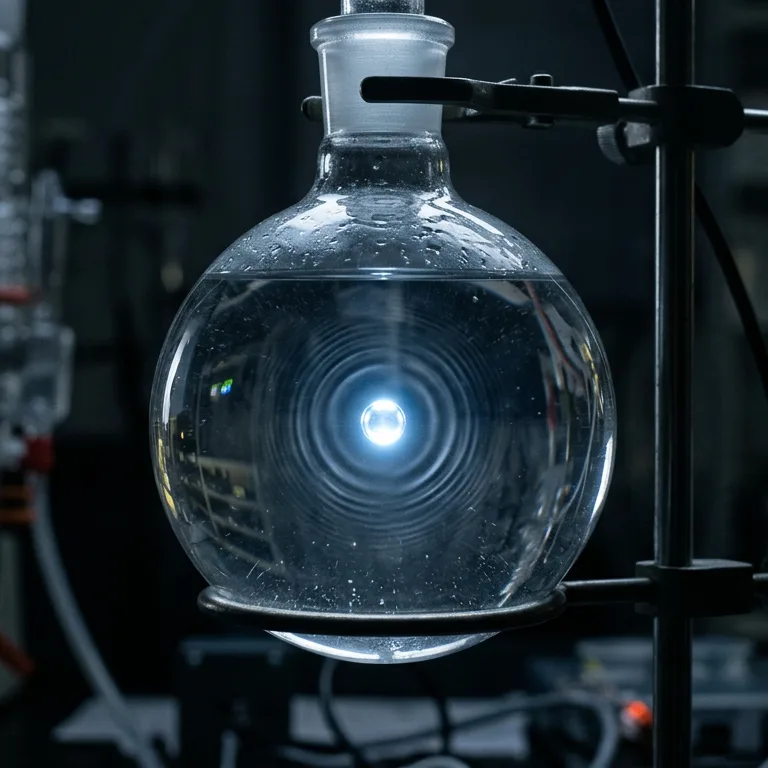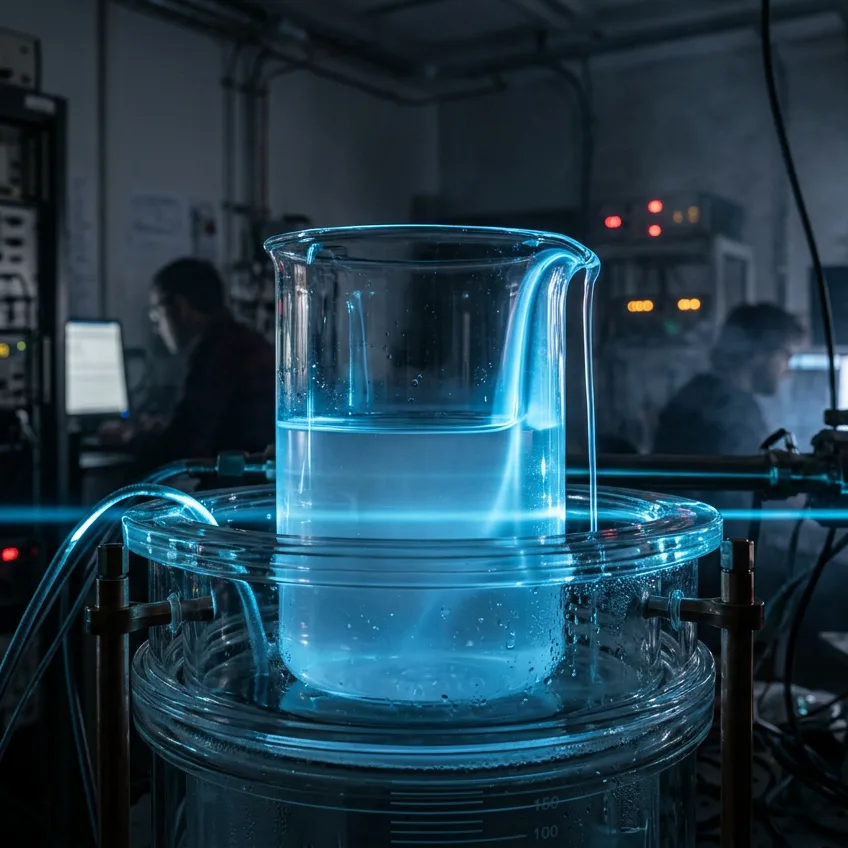
In popular physics, there is an axiom that nothing can exceed the speed of light. However, this cosmic limit of nearly 300,000 km/s applies absolutely only in a vacuum. When light passes through a dense medium such as water, its waves interact with atoms and its effective speed drops drastically to about 225,000 km/s.
It is precisely in that difference where one of modern physics' most spectacular manifestations occurs: Cherenkov radiation. Discovered by Soviet physicist Pavel Cherenkov in 1934—a finding that earned him the Nobel Prize in 1958—this phenomenon occurs when an electrically charged particle, such as an electron emitted by nuclear fission, enters water at a speed greater than light can propagate in that liquid.
Crossing water at such a 'hyperluminal' speed for the medium, the electron alters and polarizes the molecules in its path. When the electrons of these molecules return to their ground state, they release electromagnetic energy. Since the particle travels faster than the light waves it generates, these waves cannot dissipate forward and compress into a constructive front: an authentic optical shock cone, the visual equivalent of the sonic boom produced by a fighter jet breaking the sound barrier.
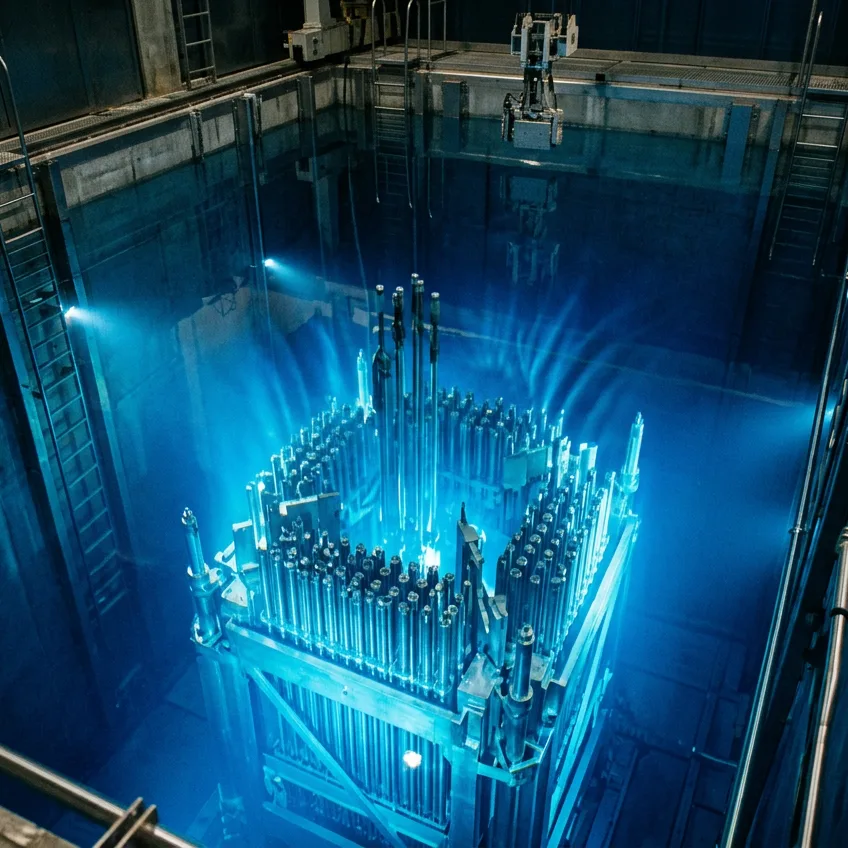
This electromagnetic shock wave concentrates in the shorter wavelengths of the visible spectrum and the ultraviolet, flooding nuclear fuel pools with a hypnotic and ghostly electric blue glow. Today, in addition to indicating reactor activity, this flash is vital for detecting cosmic neutrinos in massive underground observatories such as Super-Kamiokande or IceCube.
Source: International Atomic Energy Agency (IAEA) / Los Alamos National Laboratory