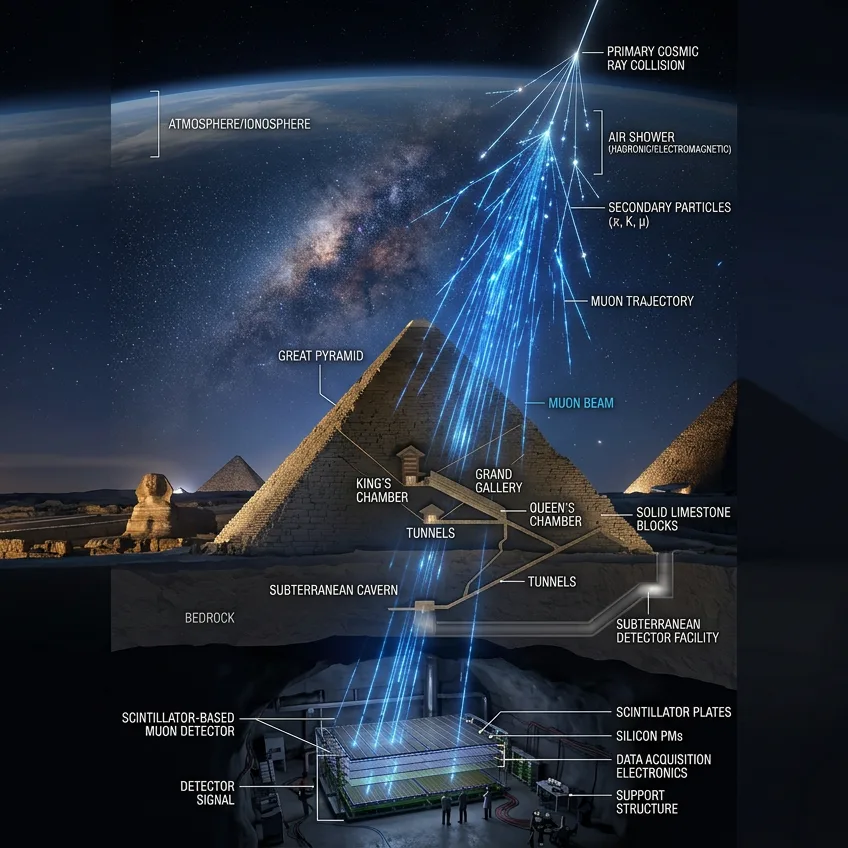
At the forefront of applied physics stands muography, a revolutionary imaging technique capable of penetrating colossal geological structures and ancient monuments without emitting artificial radiation or drilling a single rock. Its secret does not come from any Earth-based generator, but from outer space: muons, elementary particles generated when cosmic rays violently collide with atoms in the upper atmosphere.
Every minute, about 10,000 muons pass through each square meter of Earth's surface at speeds close to light. Although they behave similarly to electrons, they have 207 times more mass, giving them extraordinary penetrating power: while X-rays are stopped by a few centimeters of tissue or bone, muons can pass through hundreds of meters of solid rock before being absorbed.
By placing particle detectors—such as scintillation plates or nuclear emulsions—at the base of or next to a colossal structure, physicists map the trajectories of muons that manage to reach the sensor:
- High-density areas: slow down and scatter more muons, projecting a dark silhouette.
- Low-density areas or voids: let a greater flow of intact particles pass through.
Thanks to this natural cosmic scanner, in 2017 the international mission ScanPyramids discovered a gigantic hidden chamber at least thirty meters long sealed inside the Great Pyramid of Giza. Today, this technology also monitors magma movement inside active volcanoes such as Vesuvius or Etna, warning of possible eruptions with millimeter precision.
Source: Nature / ScanPyramids Project (2017)