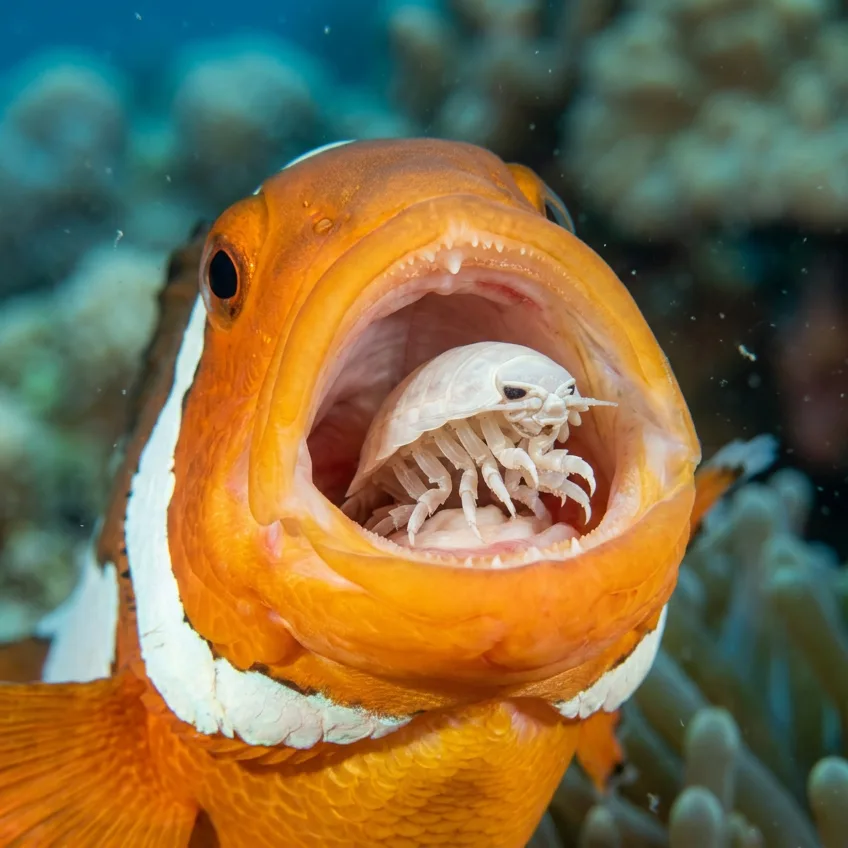
In the animal kingdom there are millions of parasitic relationships, but only one documented species has achieved an unusual biological feat: completely supplanting the anatomy and function of another organism's organ. This is Cymothoa exigua, a tiny isopod crustacean between three and four centimeters long that parasitizes marine fish in eastern Pacific waters, mainly the rose spotted snapper (Lutjanus guttatus).
The invasion process is a work of natural surgical precision:
- Infiltration and circulatory cut-off: The parasite penetrates through the gills in its juvenile phase. After maturing and changing sex to female, it climbs into the oral cavity, where it hooks its sturdy, hook-tipped legs directly into the lingual base.
- Induced atrophy: By piercing the main vessels, it intentionally strangles the blood supply to the tissue. Deprived of oxygen and nutrients, the fish's tongue necroses and eventually detaches completely.
- Mechanical substitution: Far from causing the fish's death, the isopod attaches firmly to the remaining muscular stump using its rear claws. From that moment on, the fish is able to move the crustacean exactly like its original tongue to push and swallow food.
In exchange for this peculiar biological prosthesis, Cymothoa exigua feeds on excess oral mucus and tiny blood extractions without draining the host. It is the only known case in the entire biosphere where a parasite does not destroy the function of an organ, but physically becomes it.
Source: Journal of Fish Biology / Smithsonian Tropical Research Institute