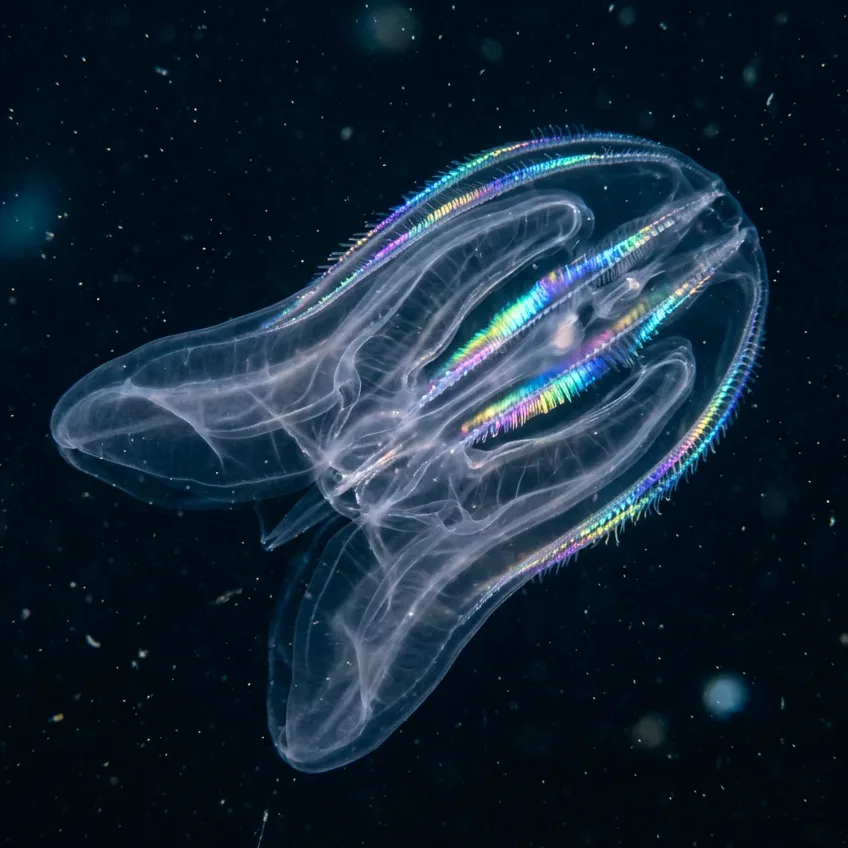
Until very recently, biology classified animals with a digestive system into two main groups: those with a blind sac (which eat and defecate through the same opening, like jellyfish) and those with a complete digestive tract equipped with a fixed mouth and a permanent anus. However, in 2019, marine biologist Sidney Tamm documented an unusual phenomenon in Mnemiopsis leidyi, a transparent marine ctenophore species: it possesses an anus that exists only at the precise moment of expelling waste.
Using high-resolution video microscopy, researchers observed that this invertebrate lacks any visible excretory pore while swimming normally. The process is triggered when undigested remains fill the internal anal canal:
- Approach and fusion: The ampulla of the gastric canal expands mechanically until it collides with the animal's outer epidermis. Both layers of tissue fuse at the cellular level.
- Opening of the pore: A transient gap opens in the body wall through which waste is expelled into the ocean in a matter of two to five seconds.
- Closure and regeneration: Immediately after discharge, the edges of the opening collapse inward and the skin cells cleanly reseal, leaving no trace or scar tissue.
In juvenile specimens, this temporary opening appears every 10 to 60 minutes. This "dynamic anus" mechanism offers a fascinating window into the earliest evolutionary steps from more than 500 million years ago, illustrating how a one-way digestive system may have emerged before animals developed permanent excretory organs.
Source: Tamm, S. L. (2019). Defecation by the ctenophore Mnemiopsis leidyi occurs with an intermittent anus. Invertebrate Biology, 138(1), e12236.