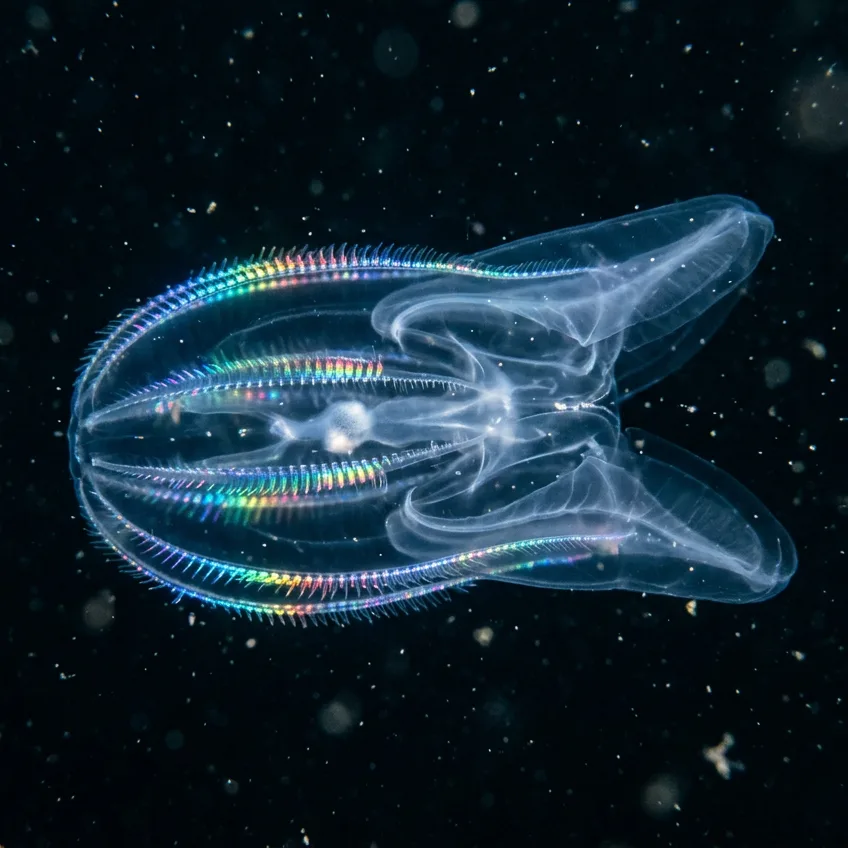
For more than a century, biologists debated how the ctenophore Mnemiopsis leidyi, a gelatinous marine invertebrate related to the most primitive branches of the animal tree, expelled its digestive remains. Many maintained that it regurgitated waste through its mouth—just like true jellyfish—while others suspected undetectable microscopic pores. In 2019, groundbreaking research led by Sidney Tamm at the Marine Biological Laboratory in Woods Hole solved the puzzle by revealing an unusual mechanism in nature: a transient anus.
Unlike virtually all animals equipped with a digestive tract, Mnemiopsis leidyi lacks a permanent anal opening. When waste particles accumulate at the blind end of its digestive canal, the gut tissue presses against the outer epidermal layer. At that exact moment, cellular magic happens:
- The membranes of both tissues fuse precisely and open a provisional gateway to the outside.
- The waste bolus is expelled into the seawater through coordinated contractions.
- As soon as the contents are released, the opening closes instantly; the cells reorganize, and the skin heals within seconds without leaving any anatomical mark.
The entire process repeats rhythmically every few hours. This finding not only challenges the classical definition of excretory organs, but it also offers a crucial evolutionary window: it could represent the transitional link between animals with a one-way digestive tract (such as sea anemones) and those with complete unidirectional digestive systems featuring a permanent mouth and anus.
Source: Marine Biological Laboratory (Woods Hole) / Invertebrate Biology (Tamm, S. L., 2019)